
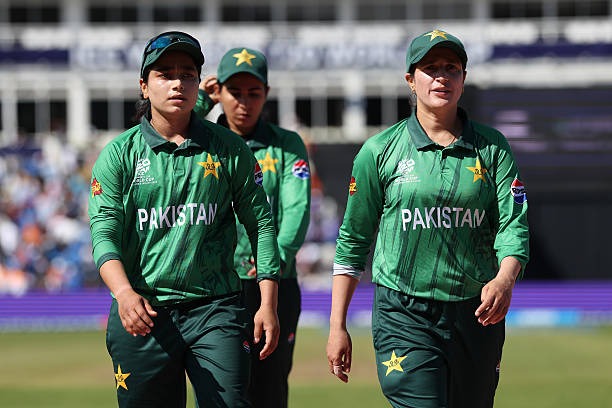
Following their disastrous performance in the Women’s T20 World Cup, where they were eliminated in the opening round, the Pakistani squad and head coach Wahab Riaz have come under fire for their off-field actions.
After losing to fierce rivals India, Bangladesh, and South Africa in Group A of the 12-team competition, Pakistan was one of the first teams eliminated from the road to the semifinals. Videos of their leisure activities during the competition went viral on social media, sparking the criticism.
While everyone wanted to promote women’s cricket and should do so, it was also a fact that women’s cricket was not progressing, according to former men’s team Test captain Rashid Latif.
“The Pakistan women’s team has been active for many years now and we need to wonder why we don’t see the required progress every time there is an ICC event,” PTI quoted Latif as saying on a podcast.
Senior player Aliya Riaz and her husband, Ali Younis, who is also the younger brother of former Pakistani captain Waqar Younis, were seen dining at a restaurant in the videos. Some players may even be skipping practice, according to rumors sparked by the footage.
Kabir Khan, a former Test cricketer and former head coach of the women’s team, questioned why seasoned players couldn’t perform well.
“These established players are not lacking in any facilities or international exposure. I just think our players are just not mentally or temperamentally strong enough to handle pressure and derail. You look at the way they lost low-scoring games to South Africa and Bangladesh in this World Cup,” he said.
Prior to the Women’s T20 World Cup, Pakistan had suffered losses in a tri-series against the West Indies and Ireland that was marred by bad weather.
According to Kabir, the present players need to be aware that they have the potential to serve as role models for future generations.
“But if you keep on disappointing, it is women’s cricket that will not progress in Pakistan,” he said.
Saleem Jaffar, a former Test bowler, stated that detractors should also take into account the cultural distinctions between men’s and women’s teams.
“For one, the women’s talent pool is not as vast as men’s cricket, and secondly, there are so many social and cultural taboos when it comes to coaching the women players,” Jaffar said.
“I give you an example as head coach. I couldn’t have a one-to-one discussion with any player without the manager being present in the conference room.”
“Male coaches have to avoid touching players in any way while coaching them in the nets. We can’t remain in the dressing room during matches because of privacy issues for the players, so all this makes it more difficult to coach the women players,” Jaffar added.
Despite a national board official outlining the measures the PCB has made, such as a separate women’s wing, Jaffar also mentioned the little pool of talent in Pakistan women’s cricket.
“The women’s team gets the same facilities, perks, fees, (and other) benefits like the men’s team. If the men’s team travels in business class, so do the women players. There is no real discrimination,” the official said.
The insider also stated that PCB has set aside its well-equipped high-performance facility in Karachi for women’s cricket, with qualified coaches, trainers, and cooks on hand around-the-clock.