
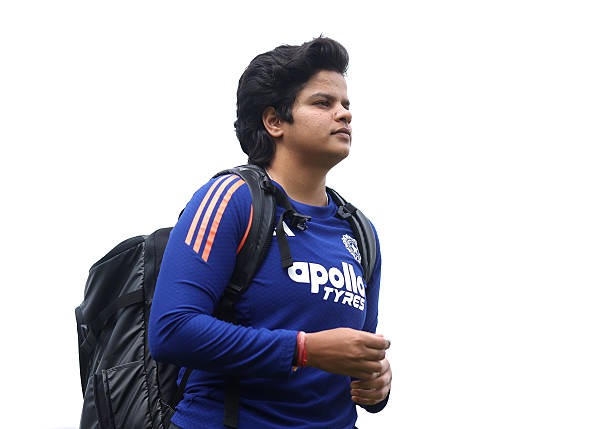
The ideal strategy for India to defeat Australia in their crucial Women’s T20 World Cup match at Lord’s on Sunday, according to explosive opener Shafali Verma, is to keep th strategy straightforward.
The group’s semi-final lineup will be decided by the two matches of the day, with South Africa (6 points) playing Bangladesh (4) at Lord’s and India (6) playing undefeated Australia (8).
India will need to defeat Australia in order to get to the final four if South Africa defeat Bangladesh. The Australians’ eight points and far higher net run rate allow them to advance even after a loss.
“Everyone knows Australia are a world-class team. But it’s not like we haven’t beaten them before. We recently beat them in a T20 series in Australia, and that gives us confidence,” PTI quoted Shafali as saying on JioStar.
In a three-match Twenty20 International series before the World Cup, India defeated Australia 2-1, and Shafali believes Harmanpreet Kaur’s team will benefit from knowing their opponents.
“We have been playing against them for years now. We know their bowlers, their strengths, and their plans. So, we will keep things straightforward, which is important, and back our own strengths. The more you overthink, the harder it gets.”
After altering her strategy after the match against Pakistan, Shafali has rediscovered her touch again. The aggressive opener, who has hit two fifties in the previous three innings, acknowledged that she overanalyzed early in the competition before choosing to follow her instincts.
“A lot of things have improved in my batting. Before the Pakistan match, I was overthinking. I was planning too much, how I would play the first ball, what shot I would play off the second ball,” she said.
“But after that game, I realised that I don’t need to complicate things. I just need to keep it simple. When I bat, I watch the ball and react. I don’t plan too far ahead. That has helped me score runs more freely.
“Because of that change, I think I am getting good scores now. I am not putting too much pressure on myself. I will try to continue this approach in the must-win game against Australia as well.”
Another crucial lesson, according to the opener, has been learning to rotate strike rather than looking for boundaries off each ball.
“If my shots are not coming off, I don’t force them. I take singles and keep the scoreboard moving. I think batting is all about not complicating things. Keep it simple, take singles, rotate the strike, and play along the ground when needed.
“If the ball is in my hitting zone, I go for it. Otherwise, I respect the good deliveries and look for ones and twos. That is the approach I have learned over time. Don’t try to hit every ball. Stay calm, watch the ball, and react. Whatever I have learned so far, this is what I have understood.”
Shafali has contributed significantly with the ball in addition to her batting. In recent games, the part-time off-spinner has bowled with the new ball and produced stats of 1/22 against South Africa, including the crucial wicket of Tazmin Brits.
Shafali had previously claimed an outstanding 3/20 against the Netherlands. She gave captain Harmanpreet credit for outlining her responsibilities in detail.
“Harman di has kept my role very clear. She told me that I will have to bowl in the powerplay. So, I work on that in the nets as well. I bowl with the new ball, focus on hitting the right areas, and try to keep the ball around the stumps.
“As an opener, I know that if you bowl outside the stumps, you give the batter room to score. So, I always try to bowl according to what I would expect as an opener, what line and length would trouble me. I bowl keeping that in mind; tight lines, stump-to-stump, and making the batter work for runs,” she said.
With lost catches threatening to ruin their campaign, India’s fielding has been a key source of concern throughout the tournament. Shafali, however, supported her teammates and insisted that the errors weren’t the result of inadequate planning.
“Everyone is thinking of giving their 100 per cent. No one is dropping catches or misfielding on purpose. Sometimes it’s just not your day, the ball doesn’t stick, the timing is off, or the bounce surprises you.
“But we always back the player who is having a tough day, both on and off the field. Our preparation has been good. We had two days of practice before this match against Bangladesh. We did fielding drills together as a team, half an hour of focused catching and ground fielding.
“So, I will not say that we are not preparing well. We are doing everything we can. It’s just about the day. Some days things click, some days they don’t. That’s part of the game,” she said.