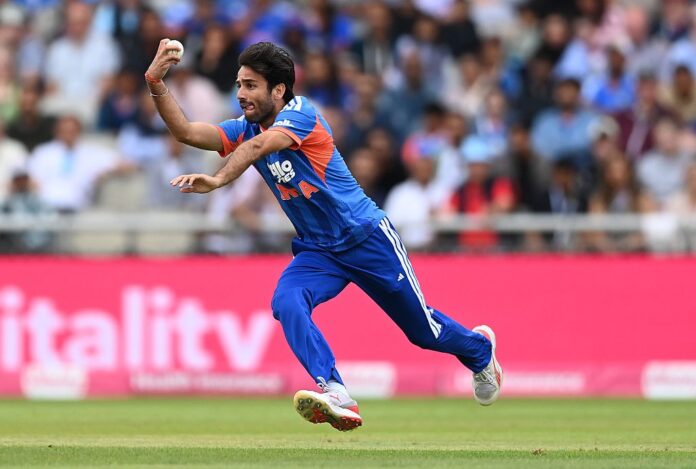
Former India left-arm spinner Murali Kartik believes Ravi Bishnoi’s back-foot no-ball problem stems from his run-up rather than his bowling action, after the leg-spinner’s repeated overstepping contributed to a costly 29-run over in India’s defeat to England in the second T20I.
According to Kartik, Bishnoi’s exaggerated semicircular run-up has disrupted his alignment at the crease, causing him to repeatedly cut the return crease. He recommended reverting to the more compact “C-shaped” run-up that had previously worked well for the leg-spinner, insisting that the issue can be corrected without overhauling his bowling action.
Bishnoi’s back-foot no-balls stem from the way he approaches the crease and gathers before release, according to Kartik. “I think back-foot no-balls happen because your run-up is like that and your load is like that. Ravi Bishnoi has had some different run-ups over the years. Even during the IPL, he had this sort of a semicircle, you can call it, or a C, whatever you want to call it. That’s the way he runs in to get to a position to bowl,” Kartik told PTI.
Kartik claims that because Bishnoi is primarily a googly bowler rather than a traditional leg-spinner, his bowling style is inherently suited to a more upright arm stance. “Bishnoi’s bowling hand comes in a perpendicular line, very straight. So as a leg-spinner, you have to be slightly away from your ear at the time of release to get the ball to spin.
“So at the time of the load, the back of your right hand should be pointing towards covers and the ball inside the palm should be directed towards mid-wicket. But Bishnoi has his right arm close to the ear because he is primarily a googly bowler, who can also bowl the slider to left-handers.”
Kartik clarified that the 25-year-old may have been a little confused after experimenting with a different run-up during the red ball season before switching back to the semi-circular run-up. “And if you remember last year when he was playing for Lucknow Super Giants, he had a very straight run-up. He has had to work things out for himself because he also played a bit of Ranji Trophy cricket that season.”
According to Kartik, Bishnoi made an effort to improve his technique when playing red-ball cricket, where a traditional leg-break becomes a more crucial weapon. “The year he played for LSG wasn’t a great year for him and he also played red-ball cricket. In that, he was trying to spin the ball, which meant his arm was away from his right ear. I’ve got video footage of it from the IPL. The year before, when he was doing well and had come onto the scene, he had a bit of this semicircular run-up. Not as exaggerated as we have seen in the last game.”
He remembered that before the changes impacted his rhythm, Bishnoi’s early IPL success came from his natural approach. “Even during the IPL, when he started off, he started really well. He was the Purple Cap holder after the first few games and then he lost his place after going for runs.
“What he himself said was that while trying to bowl with the red ball, he didn’t know where his lengths were in T20 cricket. One of Bishnoi’s strengths is that he’s quick through the air. He gets the ball to slide into a right-hander or slide away from the left-hander. Because he’s not a tall guy, the ball tends to scoot, which means it’s not easy to get underneath it and hit.”
According to Kartik, a bowler can’t concentrate on the delivery he intends to bowl once he gets aware of back-foot no-balls. “When you’re thinking of the return crease, then you’re not thinking of the delivery that you want to bowl. What he has to do is figure out a way to get that semicircle small so that his run-up is fine,” he said.
Kartik believes that Bishnoi can learn from bowling coach Sairaj Bahutule what worked for him when he took so many wickets. “The spin coach can impress upon him that this is what you did, show him footage of his old bowling and try to get him back into that space. Whether he can do it in two days depends on the individual and how comfortable he is, but technically it should not be very difficult.”
Citing some of the game’s most unusual greats as examples, Kartik also warned against forcing bowlers with distinctive motions into textbook tactics. “(Jasprit) Bumrah wouldn’t have been Bumrah if a biomechanics expert had sat down and told him exactly what to do. (Lasith) Malinga wouldn’t have been Malinga,” he said.
Rebuilding an action from the ground up is rarely simple and frequently takes years, he continued. “To unlearn and relearn, to go back to the drawing board, is never easy. It takes quite a few seasons out of you. I’ve seen very few bowlers who can actually do it. Think of Sunil Narine. When he had to remodel his action, it took him a long time to become the Sunil Narine that he is now. It is never easy to find your groove again.”