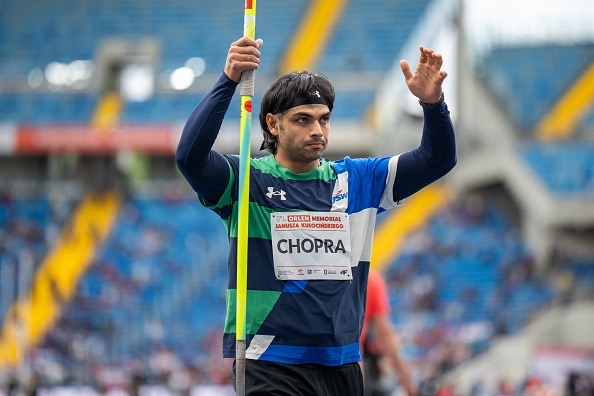
Neeraj Chopra was the biggest saving grace for India’s doping-plagued athletics scene despite a rare dip in form. He managed to get the 90-meter “monkey off his back” while the sport’s authorities worked to turn the nation into a major event hub in a bitter-sweet 2025.
In the Doha Diamond League, the 27-year-old Chopra exceeded the coveted mark, which is regarded as the gold standard in javelin throw, but he was devastated to not win a medal in the World Championships final in Tokyo later that year.
With a fourth-place result, young Sachin Yadav surpassed Chopra to become a future world-class javelin thrower.
Several elite Indians, including Olympian javelin thrower Shivpal Singh and former Asian Games medalist discus thrower Seema Punia, were caught in the net, but the doping threat showed no signs of abating.
Two juvenile athletes were added to the Hall of Shame, and an athlete-coach team was suspended for doping in a first-of-its-kind case. However, there was a bright side: Chopra hosted and won one of the two World Athletics Continental Tour events held in India.
Additionally, the nation submitted bids for a number of prestigious continental and international events, such as the 2031 World Athletics Championships, which Ahmedabad was suggested to host.
Chopra, one of the nation’s most eligible bachelors, married tennis player Himani Mor in a small wedding in a private resort in Himachal Pradesh, attended only by close family members. Only when Chopra shared the wedding pictures on his social media accounts did the general public learn about the occasion.
A few months later, Chopra became the third Asian and 25th person overall to accomplish the feat by sending his spear to 90.23 meters. Chopra won three additional major championships: the first NC Classic, the Golden Spike meet, and the Paris Diamond League. His desire of throwing a top-notch event in front of his family and home crowd came true.
However, he lost against German Julian Weber in the Diamond League Finals. He was barely able to reach the 85-meter barrier in his effort to reclaim the trophy he had won in 2022.
However, the most unexpected event occurred in September at the World Championships in Tokyo, the same venue where he won an Olympic gold medal in 2021.
Defending champion Chopra was eliminated after the fifth and last round due to back problems, finishing seventh overall with a best effort of 84.03m.
Yadav, a debutant compatriot, outperformed him with a respectable fourth-place result (86.27m).
Since capturing gold at the 2021 Tokyo Games, Chopra, who also took home a silver in the 2022 edition, has never placed outside of the top two. He has since won or placed second in 24 international competitions.
The constant threat of doping With 128 athletes on the Athletics Integrity Unit’s (AIU) list of athletes unable to compete owing to drug offenses, India remained in second place worldwide.
Shivpal, Pune Half Marathon champion Pradhan Vilas Kirulakar, sprinter Sekar Dhanalakshmi, and 2014 Asian Games gold hammer thrower Manju Bala were among the nation’s top athletes detected doping.
The National Anti-Doping Agency (NADA) also imposed three-year bans on two youngsters.
Ramesh Nagpuri, the former head coach of the Indian youth squad, was punished for “complicity” in doping.
Karamveer Singh and Rakesh, two other trainers, were suspended for “complicity” and “administration of prohibited substances,” respectively.
Long-distance runner Kartik Kumar, who won the silver medal at the Asian Games, agreed to a three-year penalty from the US Anti-Doping Agency after testing positive for many prohibited anabolic substances during tests conducted outside of competition.
Sanjana Singh, an 18-year-old who had won gold in the women’s 1500 and 5000 meters at the SAAF Senior Athletics Championships in Ranchi, and her coach, Sandeep Singh, were placed on temporary suspension for doping near the end of the year.
Later, Seema Punia, a former Asian Games gold medallist in discus throwing, received a 16-month penalty for failing a dope test, adding to her patchy doping history that includes two prior infractions, one of which occurred at the junior level when she was just 17.
The AFI established an anti-doping cell to find instructors and training facilities accused of substance misuse after becoming alarmed by the increase in doping cases.
Additionally, starting this season, all coaches—qualified or not—must register on its portal in order to continue instructing athletes. Additionally, it would not suggest anyone for national awards like the Arjuna and Khel Ratna award if they practice under unlicensed trainers.
On August 10, India successfully held a bronze level World Athletics Continental Tour competition at Bhubaneswar’s Kalinga Stadium. Next year, on August 22, 2026, at the same location, the event will be elevated to silver level. India also submitted bids for the 2026 Asian Relays and the 2028 Asian Indoor Athletics Championships, which would be held in Bhubaneswar.
In order to get ready for the 2028 Asian Indoor Championships, for which it has submitted a bid, the AFI has chosen to hold the National Indoor Athletics Championships in Bhubaneswar in March the following year.
In the meantime, 2002 Asian Games gold-winning shot putter Bahadur Sagoo succeeded Adille Sumariwalla as AFI chief.