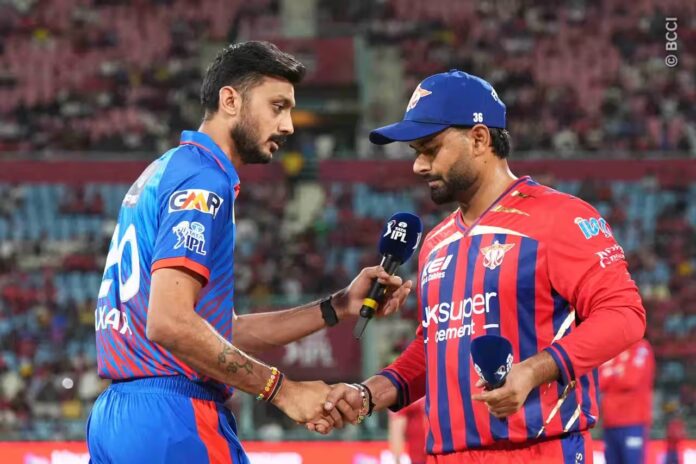
According to sources monitoring developments in various franchises, three IPL captains are under criticism for campaigns that have been nothing short of terrible, and they may lose their jobs when the season ends later this month.
After serving as captains for two seasons in a row, Axar Patel, Ajinkya Rahane, and Rishabh Pant all failed miserably in their attempts to lead their teams to the playoffs.
Pant is the biggest casualty following consecutive bad seasons as only the Lucknow Super Giants are officially ousted. However, the Delhi Capitals, led by Axar, and the Kolkata Knight Riders, led by Rahane, are also unlikely to be present during the high-profile league’s final stretch.
Axar’s stats as a player and captain don’t look good. Despite batting primarily in the top five, he has only amassed 100 runs in nine innings at a strike-rate of 112.50, with 56 coming in one innings and the rest 44 spread over eight knocks. Axar has taken 10 wickets at an economy rate of 8.08 while bowling just 36 overs in 12 games—exactly three overs per game.
Even while the economy rate appears reasonable in light of fellow spinner Kuldeep Yadav’s predicament, Axar has frequently under bowled. Due to the Delhi Capitals’ equal ownership arrangement, which divides management duties between JSW and GMR in alternating cycles, Parth Jindal and JSW will oversee cricket operations in the upcoming season.
“With Axar completely failing to prove his leadership worth and mostly being dependent on Hemang Badani and Venugopal Rao for decision making, it will be a miracle if he retains captaincy next year. The entire coaching staff is also unlikely to be retained,” PTI quoted an IPL source as saying on conditions of anonymity.
It has not gone unnoticed that a flashy batter like Abhishek Porel was ignored, that an all-rounder like Madhav Tiwari was not often used, and that a young player out of sync like Sahil Parakh was thrown into the deep end with the expectation that he would do a Vaibhav Sooryavanshi. Unquestionably talented, Parakh is still a work in progress.
Axar may still be retained as a player with mega auction scheduled for 2027, but there hasn’t been much indication of dynamic leadership thus far. Axar’s position as leader is undoubtedly uncertain as decision-making authority moves from GMR to JSW.
In Pant’s instance, it is generally known in franchise cricket that he dislikes being captain. Pant has experimented with batting at various locations, but it has frequently appeared as like he is bearing a heavy load.
Failing to qualify for two consecutive seasons is unlikely to sit well with LSG owner Sanjiv Goenka in a franchise ecosystem where immediate results are the norm. Goenka is well-known in franchise circles for being prepared to pay high dollar—nearly USD three million in Pant’s case—but also for demanding performances that are commensurate with the compensation.
By today’s T20 standards, Pant’s 251 runs with a strike rate of 138 is subpar. He has only hit nine sixes in 11 games, which is indicative of the pressure he is under.
Even ardent LSG admirers are confused by some of the team composition choices, and the flow that once characterized his batting appears to be absent. Why was Arshin Kulkarni forced to open in the IPL when his Syed Mushtaq Ali Trophy strike-rate as an opener stays around 134? His 17 off 24 balls as an opener in this day and age is unbelievable.
Was it coach Justin Langer and the support staff who answered the phone, or was it Pant? Even after Kulkarni, there are still concerns over Himmat Singh’s repeating chances, as his local T20 strike rate hardly surpasses 130.
In a similar vein, why was Ayush Badoni consistently favored in the top half even though he lacked the strong power game required in contemporary T20 batting? The campaign was undoubtedly severely harmed by Nicholas Pooran and Aiden Markram’s poor play, but Pant never appeared to be a captain with the tactical sense required for this format.
Due to the absence of viable leadership options for the team, Rahane’s employment at KKR was essentially a typical TINA (There Is No Alternative) situation. The fact that head coach Abhishek Nayar, a former teammate from Mumbai, was in charge also helped.
However, Angkrish Raghuvanshi, a protégé of Rahane and Nayar, was unable to match the pace required of top-order hitters in contemporary T20 cricket, which hindered KKR. While captain Rahane scored 237 runs at a strike rate of 133, Raghuvanshi scored 340 runs at a strike rate of 139 or higher. They both batted in the top three, which caused them to lose momentum in nearly every game.
The pair averaged just two sixes each game, totaling just 25 sixes in 11 games. Ideally, Rahane and Raghuvanshi shouldn’t have been in the same starting lineup, and the team suffered as a result of the management’s obstinacy.
When asked about his strike rate earlier in the season, Rahane mentioned that people were envious, but at 37, he might need to consider whether he can still stay up with the evolving demands of Twenty20 cricket.
It is reasonable to say that Rahane is unlikely to draw attention from any club in the next mini-auction unless KKR, in a strange decision, opt to stick with him for one more season, even though Axar and Pant will still be in demand as players.