
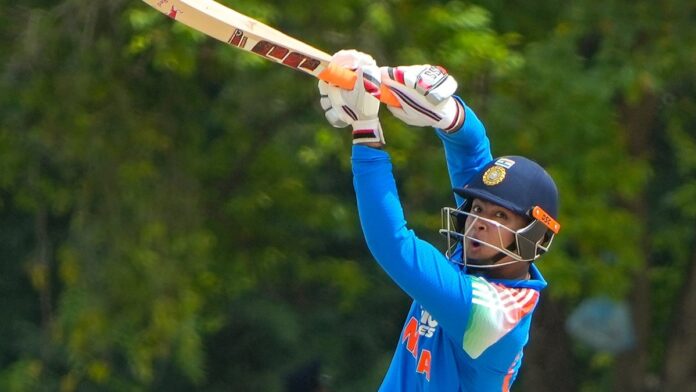
Sledging would be a common strategy to agitate Vaibhav Sooryavanshi as his stature increases, and according to experts, the rising Indian batting sensation will require “situation management” instruction to prevent losing his cool like he did during a recent India A game in Sri Lanka.
The 15-year-old is currently the most talked about teenager in international cricket and as his influence on the game becomes stronger, other teams will try to touch some raw nerves to distract him. According to a well-known psychologist, the power hitter must be ready to tackle the situation.
“I have had the opportunity of working with Vaibhav at National Cricket Academy 2-3 years back, along with a group of under-16 boys and he is a calm boy. So, the BCCI and the NCA (now Centre of Excellence), headed by VVS Laxman, already understand the importance of it and that is why players are profiled in sports psychology services whenever there are camps,” Dr Swaroop Savanur, a prominent sports psychologist in India, told PTI.
In addition to the BCCI and the Center of Excellence, Savanur has collaborated with the India Under-17 football team, Vidarbha, and Punjab Kings in the Indian Premier League.
In a recent close encounter that India A lost in Dambulla, Sooryavanshi made news by responding violently to insults from the Sri Lanka A players. Savanur stated that although skill is the primary factor in a player’s development, mind control is also essential for significant accomplishments.
“To help the players slowly understand their mindset and slowly develop a way to work on it. I have conducted 18-19 high performance camps for young cricketers at the CoE even when Rahul Dravid was heading it. Now, it has become a standard practice,” Savanur said.
“But more work needs to be done because we see so many wonderful players at the under-19 level. But they are unable to see that kind of success when they are going at the senior level. The talent was there, the intention was there, the technique and workmanship was there,” he lamented.
The importance of developing “situational intelligence” was emphasized by Savanur.
“If it does not get developed, then unfortunately the talent does not get expressed at all. So whether Vaibhav has it or not is not a question. It’s more about understanding the personality behind him, and then working on it,” he added.
Following the retirement of veterans like Virat Kohli, Rohit Sharma, R Ashwin, and Ravindra Jadeja from a variety of forms, the Indian cricket team is going through a period of transition, with a number of new players attempting to establish themselves. The need of mental preparation was emphasized by a former top national selector.
“There is no doubt about the talent of young cricketers. But sometimes, they will be in a hurry to achieve certain records or milestones in their career as they are coming in place of some high-achieving individuals. It’s a dangerous thing to do as it can lead to anxiety.
“They should be given proper counselling by the BCCI, and the team management should sit down with the newcomers and take them into confidence, saying stuff like ‘don’t hurry yourself’ and ‘we are behind you’. It will calm a lot of nerves and prepare them for a bigger stage,” he said.
Savanur acknowledged the point and stated that in order to close the gap between potential and performance, the sporting ecosystem must have empathy.
“Everybody says sports is 90 per cent mental game. So, the awareness is there. But the awareness is still in a very skewed manner. I think the sporting ecosystem is looking at it as a problem-solution approach, that having mental challenges in sports, having pressure and anxiety is somehow a problem.
“And that is the reason why people are, although wanting to work on it, still unable to work on it. So, this awareness about mental preparation should be integrated as a routine in your sport. So, that is a fundamental change that the ecosystem needs to have, whether it’s coaches, parents, or the athletes themselves.”
With 776 runs at a strike rate of 237.31, Sooryavanshi became the Orange Cap holder for the Rajasthan Royals in the IPL this year. According to Savanur, mental training aids players like Sooryavanshi in overcoming setbacks, which are an unavoidable aspect of competition. According to Savanur, this awareness and the ensuing constraint become apparent with time.
“At that moment of time, in those crunch seconds which matter, if I’m unable to apply a solution, then I’m not able to control my mind and that is what differentiates a good and great athlete. It’s not magical but a logical process. “When you are working on mindset, it is not going to be dramatically visible. It is going to be visible subtly. It is going to be visible through change in match preparation, thinking about the game, and thinking during a tough situation,” he explained.