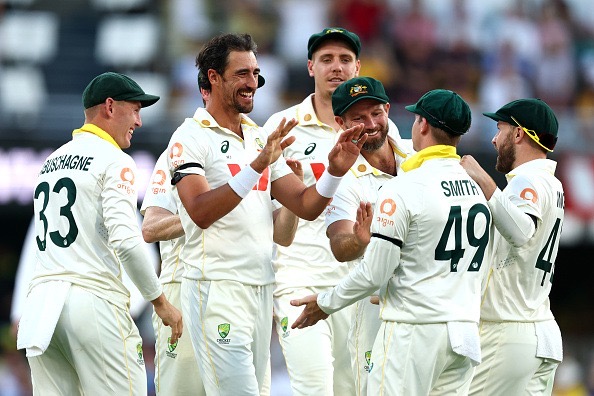
After just six days of cricket, a well-prepared Australia is on the verge of retaining the Ashes, which is not bad for a side that was criticized by former England pacer Stuart Broad prior to the start of the series as its weakest since 2010.
Going into the third Test at Adelaide on December 17, the hosts lead 2-0 and only need a draw to retain the renowned urn and further embarrass Ben Stokes’ men.
Despite the absence of injured pace leaders Pat Cummins and Josh Hazlewood, Australia has put itself in danger, and their depth is demonstrated by the performances of stand-ins Michael Neser and Brendan Doggett.
“The great and the healthiest thing for Australian cricket right now is that they’ve got almost a second XI or an Australia ‘A’ side that could come in and play some outstanding cricket too,” said former Australia pacer Brett Lee.
“The guys who have had their opportunity, the Doggetts and the Nesers, have stood up. They’ve taken their opportunity and taken it with both hands, which is brilliant.”
Australia’s talent depth was underlined as Australia ‘A’ hammered England’s second-string side by an innings and 127 runs at Allan Border Field, even as Stokes’ men were being outplayed in the second Test at the Gabba. Youngsters Fergus O’Neill, Cooper Connolly and Campbell Kellaway impressed, while out-of-favour Test batter Nathan McSweeney issued a timely reminder to selectors with a commanding double century.
With seamer Broad’s remarks coming back to haunt him, it is a far cry from the pre-Ashes war of words when England was hailed as having their greatest opportunity in a generation to win a series in Australia.
“It’s probably the worst Australian team since 2010 when England last won and it’s the best English team since 2010,” said Broad, who retired in 2023 and is now working as a commentator. “It’s actually not an opinion, it’s fact.”
He cited concerns about Australia’s batting lineup composition and a perceived lack of bowling depth at the time. They’ve both been blasted out of the water.
With the uncapped Jake Weatherald serving as Usman Khawaja’s sixth opening partner since David Warner’s retirement over two years ago, Australia entered the first Test in Perth plagued with doubt. Strangely, back spasms prevented Khawaja from batting in the first innings; Marnus Labuschagne took his place.
However, Travis Head’s incredible 69-ball century to win the match turned the tide against England when Khawaja pulled out once more in the second innings.
“Ever since Travis Head stuck his hand up to open when Khawaja got hurt in Perth, Australia have looked like a different team,” said Australian legend Glenn McGrath.
In Brisbane, Labuschagne claimed that the confidence of Head and Weatherald spread to the lower order, when he, Steve Smith, and Alex Carey all scored brisk half-centuries.
For the third Test, selectors must decide whether to stick with Weatherald and Head, whose home ground is Adelaide, or call up now-fit Khawaja, an 85-Test veteran.
Australia’s success thus far, according to Steve Smith, who replaced Cummins as captain during the first two Tests, is due to their ability to adjust “in real time.”
“We play ‘live’. We adapt on the go, instead of getting back in the sheds and going, ‘We should have done this’,” he said. “Sometimes it’s just playing the long game. I think we’ve just adapted so well the last couple of years, and played in real time, I suppose.”
Greg Chappell, a former captain of Australia, believes that England’s shortcomings have contributed just as much to Australia’s success.
Their aggressive “Bazball” style may work well on short fields and flat English pitches, but Australia’s bigger boundaries and demanding conditions have severely exposed it.
“The failure that has ensued across the first two Tests is a whole-of-system one, a catastrophic breakdown of both the game plan and its execution,” he wrote in a column.
“While the players have been the immediate culprits, the off-field leaders -– (coach) Brendon McCullum and Ben Stokes -– are equally responsible for not recognising the different challenges presented by Test cricket in Australia.”