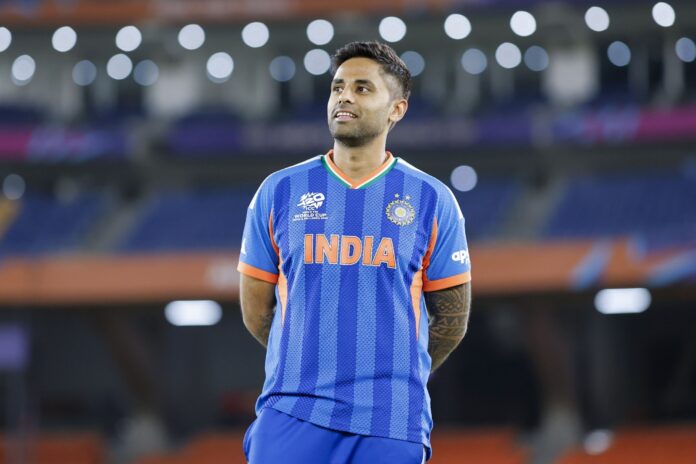
Suryakumar Yadav, the captain of India’s T20 World Cup-winning team, believes that the nation’s talent pool in the shortest format has expanded to the point where it could easily field two or even three international-caliber teams simultaneously, highlighting the depth produced by a flourishing domestic structure and franchise ecosystem.
India’s dominance in T20 cricket has been strengthened by a steady stream of players emerging from domestic competitions and the Indian Premier League, according to the flamboyant batter, who has overseen a period of remarkable consistency since taking over the leadership after the ICC Men’s T20 World Cup 2024.
The Indian team has won 42 of the 52 games played since Suryakumar took over as captain in 2024, immediately after Rohit Sharma retired following the T20 World Cup victory in Barbados. This shows the team’s supremacy in a volatile format.
Suryakumar referred to the current side as “the best T20 team India has produced” in a podcast interview with PTI Videos on Sunday, saying that India’s depth in T20 cricket is now too obvious to be minimized.
“If you talk about talent, I feel you can find talent regularly. There is IPL cricket, franchise cricket, then there is domestic cricket. You can see how many players come every year. So you can make as many teams as you want in T20 when I am talking about T20,” Suryakumar said.
“So I feel talent is unlimited. If you can make two-three playing XIs, our base is so strong, of the Indian team. So this is not a modest and diplomatic reply. But now it is so strong, so there is no shame in telling the truth,” he said.
Suryakumar attributed the team’s success prior to the World Cup to a team-wide strategy in the locker room, stating that a common goal among players and support personnel contributed to an outstanding 80% victory percentage in a format that is infamously unpredictable.
The T20 World Cup was going to be difficult despite that success record because, as Suryakumar pointed out, “we played bilateral matches one way, and in ICC tournament something else happened.” He had to inspire the team to continue their winning run in the tournament from February 7 to March 8.
“I don’t pay too much attention to statistics but I hate losing any game. If everyone in the dressing room moves in the same direction, only then can you achieve such a percentage,” he said.
A solid leadership team under the direction of Suryakumar and head coach Gautam Gambhir has been widely credited for India’s success in T20Is over the last 18 months.
Suryakumar, who is well-known for his 360-degree strokeplay, explained that batting in Twenty20 cricket is primarily a reactionary sport, with preparation playing a minor role.
“I feel batting is about 70-75 per cent reaction. The remaining 25 per cent is instinct, what you decide to do in the moment. Once you enter the ground, you are almost in autopilot mode. You try to bat with rhythm and according to the situation,” he said.
Additionally, he linked his unusual variety of shots to his early rubber-ball games in Mumbai, when he had to improvise due to inconsistent boundary sizes.
Suryakumar stated that although his bold strokeplay is frequently characterized as high risk, he strives to maintain a balance between bravery and recklessness.
“There is a very thin line between being courageous and being reckless. I try to stay on the courageous side. But if the situation demands a high-risk shot, you have to take it. High rewards often require high-risk decisions,” he explained.
The captain also emphasized his close working connection with coach Gautam Gambhir, stating that the two were nearly in sync when they initially sat down to choose the team after Gambhir took over as coach and he was given the team’s leadership.
“Out of 15 names we both suggested, 14 were common. That means the thinking was the same. When the goals are clear, there are no arguments, only discussions.”
According to Suryakumar, their personal dynamic hasn’t changed despite their professional achievements.
“I still call him ‘Gauti bhai’. It is like a younger brother and elder brother relationship,” he said.