
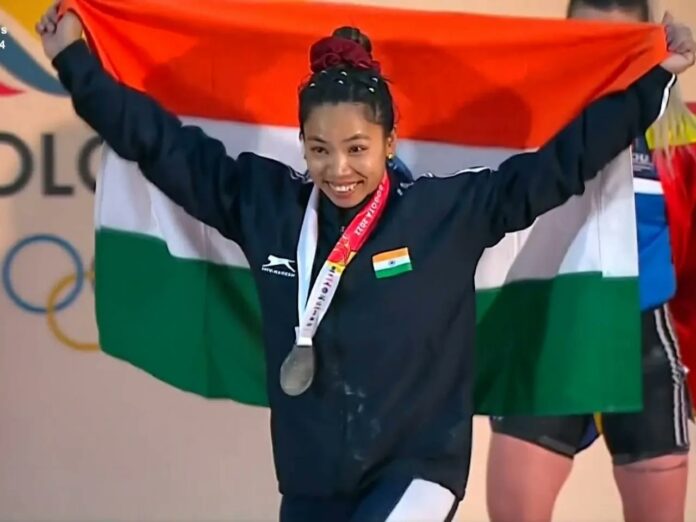
In a year characterized by drug suspicions and senior-level stagnation, Indian weightlifting once again revolved around the everlasting brilliance of Mirabai Chanu, whose silver medal at the World Championships was the sport’s greatest accomplishment.
The silver medallist from the Tokyo Olympics won gold at the Commonwealth Championships at home after missing more than a year due to injury.
Even though she was still unable to achieve the elusive 90 kg snatch lift, she went on to add a World Championships silver in the 48 kg division, solidifying her position as the sport’s flag-bearer.
After being sidelined since the 2024 Paris Games, Chanu made a triumphant comeback to competition by winning the gold at the August Commonwealth Championships in Ahmedabad, albeit against a weak field.
She added a third World Championship medal to her sparkling prize collection to maintain the momentum. With a combined lift of 199 kg—84 kg in the snatch and 115 kg in the clean and jerk portion—the silver medal was won at Forde, Norway.
But the Manipuri lifter not only failed to improve her personal best performance, but she also failed to achieve the coveted 90kg snatch.
“In the context of Mirabai, this year has been good. She came to competition after a long time, and won a silver medal at the World Championships which was uplifting after the failure of Paris Olympics,” a PTI report quoted chief coach Vijay Sharma as saying.
The International Weightlifting Federation altered the Olympic weight divisions for the second time in a year, which may have presented her with a new difficulty. Chanu’s current 48kg category was removed from the Olympic schedule in the most recent reorganization.
Chanu will therefore finally have to advance to the Los Angeles Games’ lowest women’s division, the 53 kg class. She will continue to compete in the 48kg division for the time being, keeping an eye on the upcoming Asian Games, where she hasn’t been able to win a medal.
Other than Chanu, none of the senior lifters’ performances during the season were particularly noteworthy. Even while Indians won medals at the Commonwealth Championships against a weaker competition, none of their performances were up to par.
Nirupama Devi placed fourth in the women’s 64kg division at the Asian Championships, while Dilbag Singh placed ninth in the men’s 96kg division. These results demonstrate that India can still only maintain its supremacy at the Commonwealth level.
Indian weightlifting was once again plagued by the enduring threat of doping.
Based on data from 2024, the World Anti-Doping Agency (WADA) identified India as the worst doping offender for the third year in a row, with weightlifting having the second-highest number of infractions.
At the Khelo India University Games earlier this month, a number of lifters reportedly vanished in action after submitting their names, demonstrating the seriousness of the matter. After anti-doping officials arrived, the tournament saw an increase in DNSs (Did Not Start) registrations.
As Indian weightlifting entered a pivotal year with the Asian Games and Commonwealth Games planned for the following season, the emergence of junior and juvenile lifters provided real hope amid the despair.
While Priteesmita Bhoi broke the youth world record in clean and jerk on her route to winning gold in the girls’ 44kg division at the Youth Asian Games later that year, Koyel Bar established two youth world records at the Commonwealth Championships held at home in August.