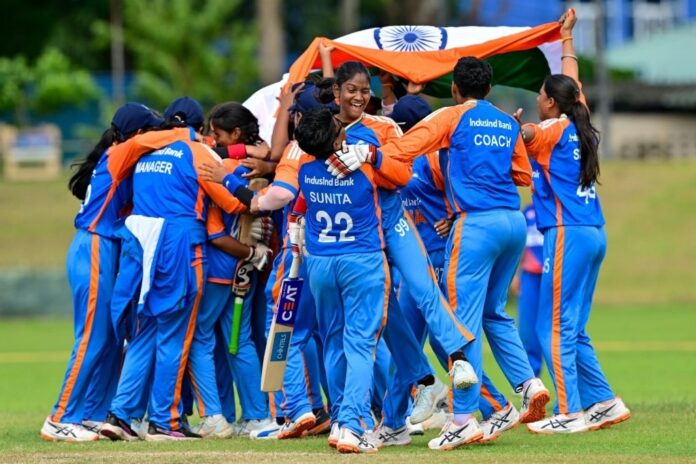
Blind Indian women won the world’s first Twenty20 World Cup title in Sri Lanka on Sunday after a competition that was thought to push the boundaries of the visually impaired.
In the final of the inaugural tournament, which also included Australia, Pakistan, Sri Lanka, and the United States, the Indian women defeated Nepal by seven wickets.
Adeline Roe, an 18-year-old from South Australia, expressed her excitement about traveling and meeting other players as well as being a member of her country’s first blind cricket squad.
“It’s amazing that we’ve got a blind women’s World Cup… It’s been a wonderful step forward for all women’s blind cricket,” Roe told AFP during the final between India and Nepal in Colombo.
“I think this is just showing how good it is for women to participate,” she said.
After leading her team to shake hands with the Pakistani players following their victory in a league match last week, India skipper T.C. Deepika garnered more sporting acclaim.
Since a deadly military confrontation between the nuclear-armed neighbors in May, tensions have been high both on and off the field.
At the Asia Cup in September, India’s players declined to shake hands with their Pakistani rivals, and neither team has shown any indications of reconciliation since.
Although it was anticipated that India’s blind players would behave similarly to their sighted counterparts, both teams greeted each other with warmth and a bond that persisted throughout the competition.
When presenting the trophy to India, Sri Lankan Prime Minister Harini Amarasuriya congratulated all of the players for their contributions to increasing awareness of the visually impaired.
“This World Cup is more than just a competition. It is a collective statement about access, equity, and the growing participation of women in sport,” she said.
“Inclusion must remain central to how we design our national and regional sporting futures, and these kinds of events truly make it possible for us to show that inclusivity in sport.”
Blind cricket players must play the shortest version of the game by ear, in contrast to able-bodied players who are required to have good vision.
A tennis-ball-sized white plastic ball is filled with ball bearings that rattle when it rolls.
When the jingling ball is delivered underarm with at least one bounce, the bowler must scream “play” after asking the striker if they are ready.
Each team comprises eleven players, much like in a typical cricket match, except at least four of them must be “B1″—totally blind. For the sake of fairness, players must wear blindfolds.
To show where they are on the field, fielders clap. Others are categorized as partially sighted based on their visual range, which is two meters (six feet) for B2 players and six feet for B3.
Up to eight players on each squad may be completely blind. A B1 player’s runs are worth two.
Meghan Whalen, a 38-year-old American player who is fully blind, finds it difficult to explain her new sport to friends and relatives back home. After visiting a seminar for the blind in April, she happened to learn about cricket.
“They were there doing a cricket demo and we got a chance to practice bowling and batting, and it was just really empowering and exciting,” Whalen told AFP.
According to her, it was a chance to challenge herself, push herself, and discover her potential.
“It was just really empowering to know that I could be an asset to a team and help build other people up, and for the visually impaired community as a whole.”