
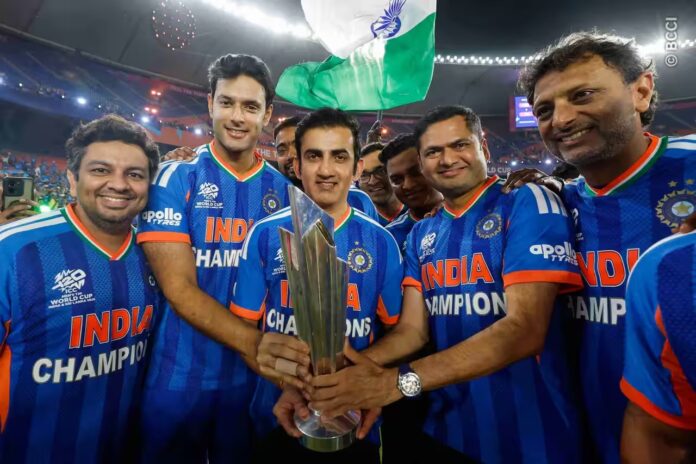
With two ICC white-ball trophies in a row, Gautam Gambhir is without a doubt the most successful head coach of India’s men’s cricket team. He has a way of getting things done, and Sunday was another excellent example of doing enough. History will decide whether he was a great tactician.
Furthermore, he is arguably the most talked-about coach in Indian cricket and has the ability to divide people. Since Greg Chappell at the beginning of the millennium, no coach has had conflicting views.
Chappell was abruptly dumped and before being turned into the pantomime villain of the past. However, Gambhir always had the support of important men in the BCCI boardroom, despite his lackluster performance in Test cricket and the difficult decisions made regarding super seniors.
Gambhir’s perseverance has always matched the determination he shown while batting for two days to rescue a Test for India in Napier, even though he has faced the wrath of social media, at times even unbelievable hatred and unending speculation. Gambhir’s optimism is a reflection of his character, which he adopted after realizing that “good boys” in capital cricket seldom endure the test of time.
Even though Gambhir hailed from an extremely wealthy family, not much came naturally to him. The only thing that kept him relevant in DDCA politics was his performance. He’s always had strong opinions. Whether his choices as a player, captain, and now coach were right or wrong, there was no denying the conviction behind them.
It originated from a place of integrity and confidence, strengthened by a keen sense of right and wrong. He was determined not to attend the Delhi Ranji Trophy nets till Ajay Jadeja resigned if he thought the former India all-rounder had no place there because of his alleged involvement in match-fixing.
He battled curators, administrators, and selectors for players he supported while serving as captain of Delhi. As long as he felt and spoke in a way that made sense, he didn’t care who was in front of him, whether it was Chetan Chauhan or Bishan Bedi. When he was the captain of the KKR, he fully supported a young Suryakumar Yadav if he thought that was his secret weapon.
Additionally, he felt that Surya, rather than Hardik Pandya, who appeared to be prone to injuries, was the best candidate to carry on Rohit Sharma’s legacy when he was appointed head coach of India. He would want Ishan Kishan if he thought he was necessary for the T20 World Cup. He wouldn’t listen to anyone if he thought Washington Sundar was an all-rounder that India will need in the next ten years and Harshit Rana had untapped skill.
Throughout his coaching career, whether with the Lucknow Super Giants, KKR, or now India, he relied more on instinct than on hard facts. He was an extremely instinctual leader. While some coaches prepare players for failure, Gambhir cannot be accused of having such terrible quality. He would prefer to give underperforming players a few bullets and support them till they reach their peak performance.
Abhishek Sharma at the T20 World Cup is one example. Despite having a subpar campaign by his standards, Varun Chakravarthy benefited from Gambhir’s unwavering encouragement. Gambhir never requested a replacement for Rinku Singh when his father passed away because he wanted his player to return to his squad.
Seldom would his facial features reveal his thoughts or emotions. A coach who constantly encouraged his players to play for the flag, he was a man of few words when he was an Indian player. Gambhir has always grasped the T20 format like the back of his hand, and he will continue to be a successful coach in this format in the future.
It’s a big concern whether he can carry this “Midas Touch” in Tests and 50 overs. If it occurs, Indian cricket will achieve previously unheard-of heights.