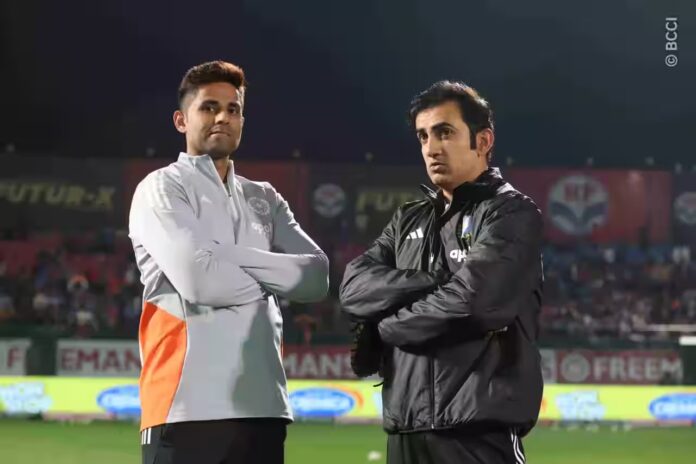
One is tempted to consider Suryakumar Yadav and Gautam Gambhir’s working relationship as India begins its T20 World Cup title defence in less than 72 hours. Based on the results, which include an incredible 31 wins in 39 games with a winning percentage of 79.48, their collaboration has been tremendous.
In Indian cricket, the most successful captains have traditionally taken precedence over coaches. The fact that it was Virat Kohli’s team and the captain was its commander was something that even the jovial Ravi Shastri, one of the brightest minds, consistently emphasized.
The captain was the team’s true ruler in the cases of John Wright-Sourav Ganguly, Gary Kirsten-MS Dhoni, and Rahul Dravid-Rohit Sharma. In terms of strategic decision-making, this is likely the first coach-captain combination since the Chappell-Dravid period when the coach has a far more dominant presence.
T20 has arguably undergone the fastest template modifications, which has called for more hands-on football manager-style coaching—a fit for Gambhir’s personality.
And in order to give Gambhir’s plans the shape they needed, one needed Surya 2.0, a guy confident in his abilities and conscious of his capacity to carry them out flawlessly. However, there have been numerous instances in the last year that indicate Surya is the executioner and Gambhir is the mastermind.
There is undoubtedly a lovely history between the two. Surya, the player, originally gained national attention while playing the finisher’s role for KKR under Gambhir’s captaincy, and the current head coach actually gave him the now-famous acronym “SKY.” It is also well known in Indian cricket that Surya pipped Hardik Pandya to become the T20 captain in 2024 thanks in large part to the influence of the then-new head coach.
Another instance is when Shubman Gill was immediately appointed vice captain for the Asia Cup in Dubai.
Those who have followed Indian cricket’s progress may attest that the captain’s last priority may have been to move Sanju Samson lower in the order. Ajit Agarkar, the chairman of the selectors, and Gambhir undoubtedly contributed to that choice.
Everyone was impressed by Surya’s composed manner and restrained approach in both situations, and that impression has persisted throughout the partnership. Gambhir and Surya have similar personalities, which frequently bodes well for the team.
Surya is from a middle-class family in Chembur, Mumbai, while Gambhir comes from an extremely wealthy business family that lived in old Rajendra Nagar in central Delhi. However, there are many parallels between them despite their relatively varied socioeconomic backgrounds and personal differences.
In Surya’s case, despite his natural aptitude, he ran afoul of the state cricket establishment due to the boldness of a novice.
Gambhir, on the other hand, never had many close pals. He always had a “come, do your work, and go home” mentality. He was intense and conscious of the fact that he wasn’t as gifted as Virender Sehwag and had to put in twice as much effort to make a name for himself on the squad. And the left-hander has had his run-ins with the state management on many occasions.
Both Surya and Gambhir are ardent patriots who flaunt this side of their personalities.
If Gambhir told Nitish Reddy that fighting on 22 yards is like “taking a bullet for the country” with intensity radiating from every feature of his face, Surya would casually chew gum instead of shaking hands with Salman Ali Agha, the captain of Pakistan, and inform a reporter from across the border that referring to Indo-Pak matches as a “rivalry” has become outdated.
When the history of the shortest format of cricket is recounted, the Gambhir-Surya combo will undoubtedly take center stage due to their shared concept of changing the grammar of T20 batting head-on.
However, it may sound harsh, but the T20 World Cup 2026 will be the only competition used to evaluate them till then.