
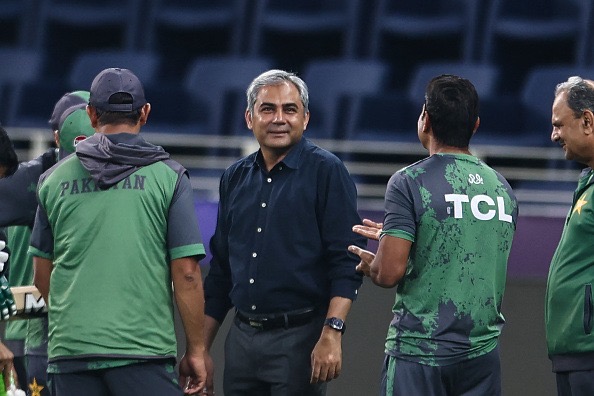
If the ICC’s strong governing board decides to punish the Pakistan Cricket Board (PCB) for declining to participate in the T20 World Cup match against India on February 15 in Colombo, the PCB may suffer enormous financial losses.
According to a PTI report, Pakistan’s portion of the ICC’s 2024–2027 financial cycle is roughly USD 144 million, with the PCB receiving the highest payout rate of USD 38 million each year.
“Basically if the ICC decides to penalise Pakistan for not playing India, the PCB could take a big hit financially as the ICC share in the current financial cycle comes to approximately 40 billion PKR,” PTI quoted an insider as saying.
According to him, the PCB has been able to maintain its financial stability thanks to these 40 billion rupees, but if they suffer a setback, Pakistan cricket will face financial difficulties.
He affirmed that Pakistan had previously received significant funding from the ICC for the 2024 T20 World Cup and the Champions Trophy, which it also hosted, as well as an extra USD 6 million from the tournament’s USD 70 million budget. According to the insider, the PCB spent a lot of money planning the event, and the sale of hospitality boxes didn’t bring in much money.
However, due to a deal between the BCCI, PCB, and ICC, Pakistan’s match versus India was played at a neutral venue in Dubai, allowing them to only play one game at home. The PCB’s earnings from the Champions Trophy have also been impacted by the approximately 18 billion rupees it spent on ongoing stadium upgrades in Lahore, Karachi, and Rawalpindi.
“The PCB is yet to get shares from the T20 World Cup this year and from the 50-over World Cup next year and that is where the ICC could impose financial penalties,” he said.
Additionally, he clarified that because the PCB signed the agreement with the participating teams for the ICC events, the ICC and the broadcasters might demand severe financial penalties from the PCB in addition to compensation if there was no cause for force majeure.
He stated that based on a rough calculation, the broadcasters, who paid the ICC USD 3 billion for the current financial cycle, rely significantly on the Pakistan-India matches to break even or turn a profit because each match is expected to bring in at least USD 250,000 million for them.
Broadcasters are assured USD one billion from four Pakistan-India matches in four ICC events this cycle. Additionally, the shares allotted to member nations will be significantly reduced if they are not held. On the surface, the PCB’s other primary revenue streams include USD 42 million in franchise fees, which will begin with the PSL 11th edition this year when two new teams are added.
Following the devaluation of the current five out of six franchises, the PCB will now receive around USD 20 million in annual fees from the two new clubs, which were sold for 175,000 crore (estimated USD 6.2 million) and 185,000 crore (estimated USD 6.65 million).
This month, the PCB will also put the Multan Sultans franchise up for auction. Based on the pattern set by the auctions of the new Hyderabad and Sialkot teams, it could sell the Multan franchise for about 200 crore, or roughly USD 7 million, which is part of the total annual franchise fees of about USD 42 million.
In addition, franchises receive 90% of the league’s total gate receipts, while the PCB distributes 95% of the PSL’s central pool earnings from the sale of media broadcasting rights, title sponsorships, and advertising. According to the insider, the national team’s sponsorship agreement and the selling of their local and home international cricket rights are also included in the PCB’s earnings.
“But the PCB also has huge expenses which include subsidising the domestic events, salaries and administration expenses, perks for around 700 to 800 employees,” he said.
He also recalled that the Pakistani auditor general’s 2023 audit report highlighted issues with obtaining the yearly franchise payments and, in certain situations, the lack of bank guarantees. Before the two new teams brought in 360 crore rupees for the board, the audit study also predicted a significant possible loss of 10.751 million rupees for the board between the seventh and twelfth editions.
Paying the contractual players’ monthly retainers costs the PCB an additional $5 to $6 million. As is customary worldwide, the PCB has not bothered to publish an annual audited financial report on its website since 2023.