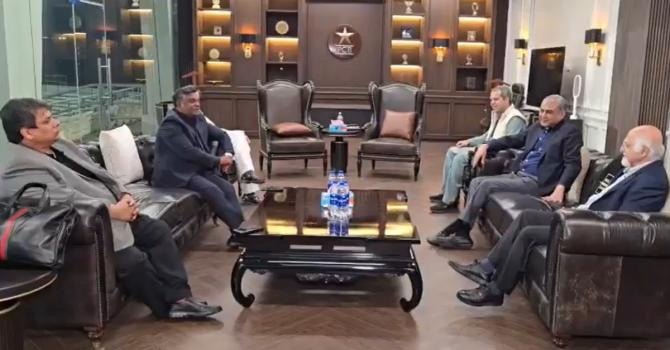
Pakistan Cricket Board chairman Mohsin Naqvi met with ICC deputy chair Imran Khwaja and his Bangladeshi counterpart Aminul Islam in Lahore on Sunday, as attempts to end the impasse over Pakistan’s planned boycott of the crucial T20 World Cup match against India pick more steam. The PCB shared pictures of the meeting, which was held at Gaddafi Stadium.
As an associate member director with voting powers on the board, Khwaja, who represents Singapore in the ICC, is a powerful figure in the global governing body. Khwaja traveled to Lahore to meet with PCB officials as there were increasing signs that the standoff over the highly anticipated match between India and Pakistan in Colombo on February 15 could be settled, allowing the game to proceed.
As an associate member director with voting powers on the board, Khwaja, who represents Singapore in the ICC, is a powerful figure in the global governing body. Khwaja has been nominated by the ICC board as a mediator on the contentious issue, according to a source close to the PCB.
“He has been in talks with Mohsin Naqvi for a while now and he is reaching Lahore today to first talk to the PCB chief and also the Bangladesh Cricket Board (BCB) President, Aminul Islam,” PTI quoted the source as saying.
Aminul is anticipated to participate in the talks meant to convince Pakistan to change its mind about not playing India in the World Cup. Senior PCB representatives met Khwaja and Aminul at the airport before they were driven to Gaddafi Stadium.
Following their conversation with Naqvi, Khwaja and Aminul would virtually meet with some members of the ICC governing body later on Sunday, according to a PCB source. According to the source, the ICC was making every effort to persuade PCB to obtain its government’s approval for the match on February 15.
Aminul arrived in Lahore before Khwaja, and his presence is important because the PCB and ICC’s disagreement started when the latter chose to replace Bangladesh with Scotland after the former declined to play in their World Cup matches in India, claiming security concerns.
Pakistan’s decision to boycott India match, according to Prime Minister Shahbaz Sharif, was made in solidarity with Bangladesh, whose request to have their matches moved from India to Sri Lanka was denied by the ICC. Naqvi hasn’t spoken much about the government’s orders to boycott the India match, but according to a trustworthy source, things have changed since the Sri Lankan cricket board emailed the PCB to ask them to lift the boycott.
Sanjog Gupta, the CEO of ICC, also traveled to Colombo to meet with Shammi Silva, the president of Sri Lanka Cricket (SLC), who emailed Naqvi to invite him to play for India in the World Cup. After the PCB attempted to skirt the issue by placing the blame on its government, the ICC has already asked Pakistan to explain how the “Force Majeure” clause can be used to defend the team’s decision to skip the T20 World Cup match against India.
However, there is now some hope because the PCB has asked the ICC to hold discussions, according to an ICC Director who believes the big match will eventually happen.
With the belief that the good of the game must take precedence over unilateral action, the ICC is now interacting with the board in an organized way to discuss potential solutions. Citing significant financial losses for all parties involved, Sri Lanka Cricket has cautioned PCB to reevaluate its choice.
After Bangladesh declined to travel to India for the T20 World Cup matches due to security concerns, Scotland took their place, and Pakistan chose to boycott the India match in support of Bangladesh.
Bangladesh’s withdrawal was prompted by the BCCI’s decision to remove their bowler Mustafziur Rahman from the KKR team.