
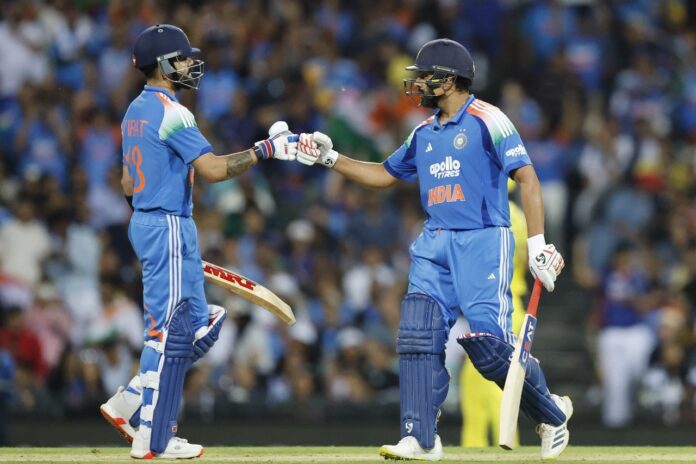
India won the third and final ODI in Sydney on Saturday by a consoling nine wickets thanks to a century from Rohit Sharma and a game-changing innings from Virat Kohli, who may be playing their final match in Australia.
Rohit (121 not out) and Kohli (74 not out) built a 168-run partnership in just 170 balls for the second wicket as India swept to 237/1 in 38.3 overs after Harshit Rana’s bowlers held Australia to a below-par 236.
The euphoric Sydney crowd got exactly what they expected from Rohit and Kohli, who delivered iconic innings and prevented the side from suffering an embarrassing whitewash as Australia won the three-match series 2-1.
Kohli looked like a mathematician diligently tackling a riddle, whereas Rohit was all fluency and full-hearted shot-making.
Rohit took up the chase in his own way and produced his 33rd ODI century after captain Shubman Gill returned to the hut after assisting his senior partner in milking 69 runs for the first wicket. In international cricket, he achieved a historic 50th century, which included five T20I and 12 Test hundreds.
After Adam Zampa was introduced, Rohit transitioned into his punishing personality after a few slick drives and flicks off Mitchell Starc.
In order to destroy Australia’s already poor spin department, the 38-year-old slog-swept Zampa for a six. He then hit a fantastic inside-out six over covers off the leg-spinner.
After getting off to a single, Kohli celebrated with a punch and a smile, making up for the two previous consecutive ducks with his signature straight drive off Starc for a four.
https://x.com/BCCI/status/1982023573402247320
However, Kohli quickly settled into a rhythm, rushing for those brief singles with sporadic boundaries.
After striking Kohli’s pads, Nathan Ellis was given the DRS. The veteran batsman exhaled with relief when the TV umpire agreed with the on-field umpire’s decision to declare him not out. Then, Kohli was at 36.
Soon after, in 63 balls, Rohit reached his fifty, and the following fifty came easily in 42 balls as the Mumbai player batted with equal parts style and aggression.
Rohit reached his 33rd ODI hundred in 105 balls, and Kohli, who had already reached his fifty off 56 balls, was soon embracing his old friend.
The Australian players gathered around him and Rohit to applaud them after Kohli hit Ellis for a four a few overs later, ending the match for India’s victory.
Even if the Sydney crowd had their fill of Rohit and Kohli, they will still feel a little disappointed. They may never see them again on these shores. However, RoKo’s final sighting was significant enough to be preserved in their memory for all time.
Earlier, Matt Renshaw showed off his recently acquired white ball skills with a brilliant fifty, but India bowlers, led by Harshit Rana, struck at regular intervals to limit Australia to a disappointing 236.
The Indians put up a good show with the ball and on the field, especially in the middle overs when spinners restricted the run flow, and the Australians, who chose to bat by choice, were unable to form consistent partnerships.
Pacer Rana produced strong pace and bounce off a new SCG turf during his four-wicket haul (4/39).
The hosts were kept afloat by a first-wicket partnership of 61 between captain Mitchell Marsh (41) and Travis Head, as well as a 54-run partnership between Renshaw (56) and Alex Carey, but they were unable to reach a higher total.
Marsh and Head hit some of their usual strong strokes around the wicket. The former had even pulled a pulled six on Prasidh Krishna. However, Head directed a pretty harmless delivery from Muhammad Siraj directly into Prasidh’s hands at backward point.
The Indians put up an improved fielding effort and Virat Kohli’s grab at backward point to remove Matthew Short from Washington Sundar is perhaps one of the greatest reflex catches ever.
That attempt was improved by Shreyas Iyer, who removed Carey with a running catch. A Rana delivery was lofted by the wicketkeeper-batter, but the ball flew in the opposite direction by a leading edge.
Shreyas ran off from point and ran a good distance to take a good overhead diving catch, though he was slightly hurt in the process.
Marsh’s defense was pierced by a delivery that came in with the angle, disturbing the stumps, and Axar Patel used his magic in between to dismiss the West Australian.
However, almost ten years after making his Test debut, Renshaw batted confidently at one end, demonstrating that he has finally adjusted to the demands of the white ball format.
His first boundary came off the 35th delivery, and he concentrated on taking singles and twos to escape the pressure the Indian bowlers put on him in the middle overs.
Despite only hitting one four, the left-hander managed to reach his fifty off 58 balls, but he was unable to prolong his stay and was dismissed LBW by Washington.
Australia were reduced to 201/7, as Mitchell Owen and Mitchell Starc did not stay long either. A few cameos later in the order added a little respectability to their total.