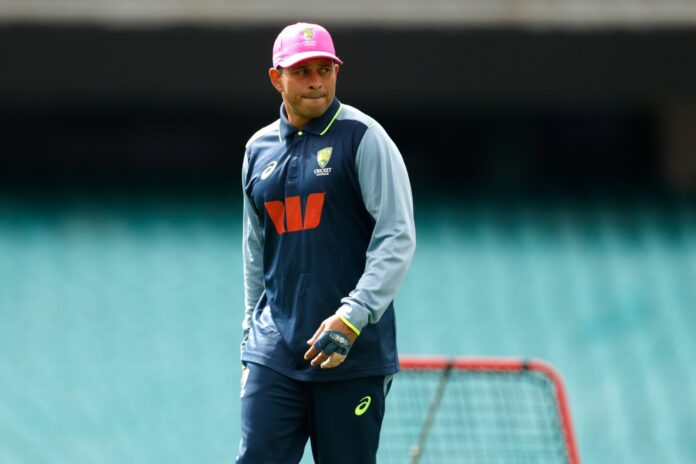
Usman Khawaja, Australia’s first Muslim Test cricketer, said on Friday that he would retire from international cricket following the fifth and final Ashes match against England. Khawaja also took aim at what he called “racial stereotyping” during his 15-year career.
The 39-year-old will pad up for the final time if he is chosen when the Test begins in Sydney on Sunday, putting an end to months of conjecture on his future.
The elegant left-hander made his debut against England at the Sydney Cricket Ground in 2011, and this would be his 88th Test match, capping a career that started there.
“The number one emotion is contentment. I’m very lucky to have played so many games for Australia the way I have,” Khawaja said. “I hope I have inspired people along the way.
“I’m a proud Muslim coloured boy from Pakistan who was told that he would never play for the Australian cricket team. Look at me now, and you can do the same,” he added.
As a child, Khawaja moved to Australia from Islamabad, where he overcame several obstacles to become the nation’s first Muslim and Pakistani national player. He was the only Asian first-class player in Australia at one point, and others look up to him as an inspiration.
“Usman has made a huge contribution to Australian cricket both through his outstanding achievements as one of our most stylish and resilient batters since his Test debut 15 years ago, and off field, particularly through the Usman Khawaja Foundation,” said Cricket Australia chief Todd Greenberg.
“On behalf of Australian cricket I would like to thank and congratulate Usman for all he has achieved.”
Khawaja’s charity provides educational support and introductory cricket programs to young people from refugee, immigrant, Indigenous, and low-income families.
In Test cricket, Khawaja, a certified pilot, has amassed 6,206 runs with 16 hundreds at an average of 43.39. A year ago, he scored a career-high 232 against Sri Lanka, but he hasn’t hit three figures since. The experienced batsman has come under scrutiny during the current Ashes series, which has been quite the rollercoaster.
After suffering a back injury during the first Test in Perth, Travis Head took his spot as opener in the second innings and smashed a match-winning hundred.
Khawaja was left off the team for the third Test in Adelaide and did not play in the subsequent game at Brisbane. However, he got a lifeline when Steve Smith withdrew due to illness just before the toss.
He came in at number four and scored 82 and 40 and made 29 and 0 in the fourth Test at Melbourne.
“I’m glad I get to leave on my own terms, with a little bit of dignity, and go out at the SCG where I love,” he said, while expressing frustration at how he was treated.
“When I did my back (in Perth), I hurt my back and had back spasms and it was something I couldn’t control. The way the media and past players came out and attacked me. I could have copped it for a couple of days but it went on for five days. The way everyone came out at me about my preparation, ‘he’s not committed to the team. Only worried about himself. Playing a golf competition. He’s selfish, he didn’t train hard enough. He’s lazy’.
“These are the same racial stereotypes (I thought we had moved past). But obviously we haven’t fully moved past that. I haven’t seen anyone treated like that in the Australian cricket team before.”
Nevertheless, he acknowledged that throughout the current Ashes series, the writing was on the wall.
“Going into Adelaide and then not being picked initially for that game was probably a sign for me to say ‘all right, it’s time to move on’,” he said.
In addition, Khawaja participated in 9 Twenty20 internationals and 40 one-day matches.