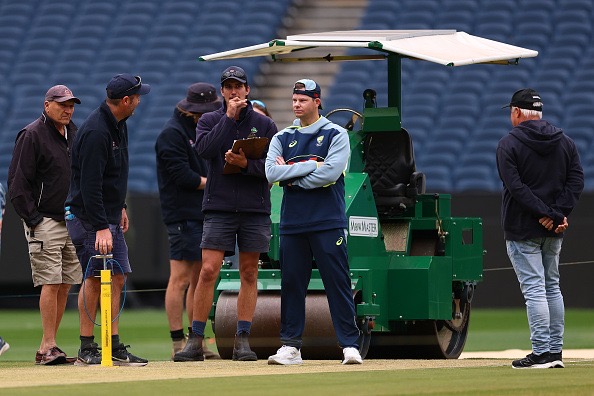
Matt Page, chief curator of Melbourne Cricket Ground, claimed on Sunday that he was in a “state of shock” after witnessing the devastation during the two-day fourth Ashes Test, which has left Cricket Australia with a millions-dollar income shortfall.
Batting became dangerous as Page and his team left 10 millimeters of grass on the pitch, giving fast bowlers too much bounce and seam movement.
England triumphed by four wickets for the first time in Australia since January 2011 as 36 wickets fell in 142 overs, including 20 on the opening day. The match was over in the second day’s evening session.
On day three, over 90,000 fans were anticipated, and on days four and five, many more. However, following the Ashes series opener in Perth similarly finished in two days, Cricket Australia risks yet another significant financial blow due to the need to refund ticket sales.
Todd Greenberg, the chief executive, calculated on Sunday that the governing body would lose almost Aus$10 million (US$6.7 million) due to the Melbourne shortfall alone.
It is the first time in 129 years that a single series has produced multiple two-day Tests, a phenomenon last seen when pitches were left uncovered and at the mercy of the weather.
“I was in a state of shock,” Page said. “I’ve never been involved in a Test match like it and hopefully never involved in a Test match like that again.
“We know this hasn’t gone as we planned. We will look at what we need to do to improve.”
A year ago, Australia defeated India in an exciting Test that lasted to the final session on day five after the grass on the pitch was cut down to seven millimeters.
Page claimed that he had to adopt a new strategy because of the chilly, rainy weather that preceded this year’s Test as well as the predicted heat on days three and four.
“We’re trying to balance that contest between bat and ball throughout, over the four or five days, to provide that captivating Test for all,” he said.
“We left it longer because we knew we were going to get (hot) weather at the back end that we knew we needed our grass (for).”
The pitch has not yet been evaluated by International Cricket Council referee Jeff Crowe, who is debating whether to award it a “unsatisfactory” rating, which would result in the venue receiving a penalty point.
The surface was criticized by a number of former greats, and also by Australia’s Steve Smith and England’s Ben Stokes.
“Being brutally honest, that’s not really what you want,” Stokes said.
Smith added: “It was tricky. No one could really get in. When you see 36 wickets across two days, that’s probably too much.”
The pitch was called “a joke” by former England captain Michael Vaughan.
Greenberg acknowledged that the financial shortfalls “sting” and announced that Cricket Australia would conduct an end-of-season review of the management of Test wickets.
“With the way batters are batting, and the way the game is evolving, are the preparation of our wickets in lockstep with that?” he told cricket.com.au.
“If they’re not, how do we make sure that they are so that we can try to balance the commercial imperatives versus the performance?”
Stuart Fox, the CEO of MCG, supported Page and his ground crew in spite of the issue.
“We bought Matt on eight years ago because he’s considered one of the best in the country, if not the best,” Fox said. “I still believe that, and I always will.
“You can see he’s disappointed. He carries that responsibility and my job as a leader is to support people.”