
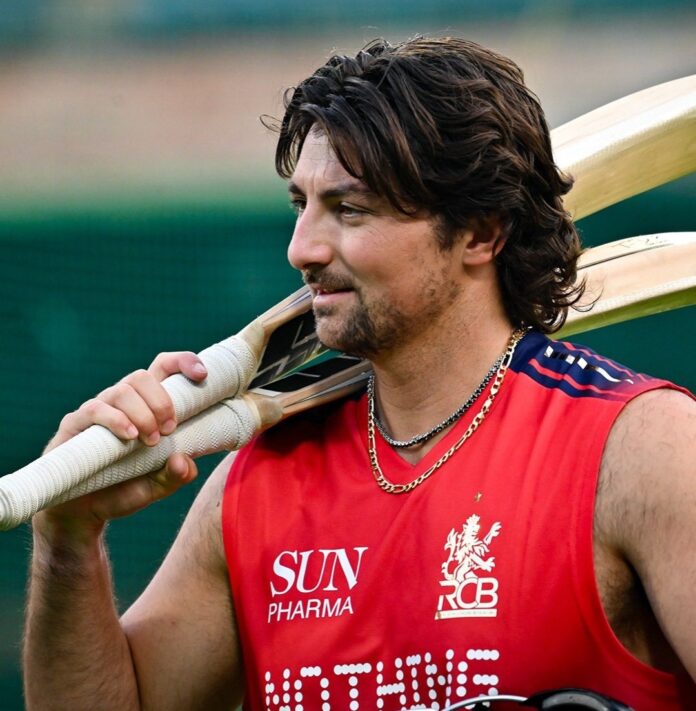
Royal Challengers Bengaluru batter Tim David acknowledges that it’s difficult to produce consistently as a finisher, but he has accepted that fact. He says it’s all about not condemning yourself “harshly” when you fail.
Last year, RCB won their maiden IPL title thanks in large part to David’s damaging willow down the order. This time around, he has also shown flashes of his power hitting.
“We have a bit of a team and as a middle-order batter in T20 cricket you can’t do finishing every game; so if you expect to do that, it becomes really difficult, so we just kind of play and try and enjoy,” PTI quoted David saying during a select media gathering.
“So a massive part of the IPL is not putting extra pressure on yourself and judging yourself harshly when you don’t come out on top,” he added.
However, David gave RCB’s top order a lot of credit for making it easier for late order batters like Jitesh Sharma, Romario Shepherd, and himself.
“So, as a middle order batter, you have to solve a problem. So we’re very lucky that we have a brilliant top order and they’re very consistent, but also put us in a good position. So a lot of the time I’m going and putting the finishing pieces, and we have myself, Jitesh from Romario; so that takes the pressure off us.”
In order to perform well during crucial moments, David also relied on his years of middle order expertise and focused net sessions.
“Fortunately, I’ve played my whole career in the middle-order, so I understand certain risks. But, certainly in practice, you have to get your volume of balls in because you don’t get to bat all the time in the matches.
“So you have to be able to hit yorkers, you have to have ways of scoring against different bowling and you understand after playing for a long time the patterns the bowlers will try to use to slow you down.
“So they’ve got lots of weapons in their arsenal now and you’ll see the summary on the TV; they talk about where the bowlers can target and they’ve obviously graphed out where batters score quickly and what they’re weak against. So, yeah, you build those foundations up and then certainly that becomes your strengths,” he said.
The Australian hitter feels that his performance in the IPL has greatly benefited from his diligent practice sessions, which have also improved him as a player against spin.
“I’ve always felt I played spin better than pace and then you come to India and you get challenged, facing the best spin bowlers in the best competition. It’s a challenge and the role I was batting in, you only come in the last couple of overs and you’re facing generally the best leg-spinner or the most attacking spinner the opposition have.
“I wasn’t happy with how I was going against the spin and the approach I had and it wasn’t really getting me anywhere so I kind of had a rethink with my coach back at home (Jim Allenby) and we talked about how I wanted to play spin and maybe there were some technical adjustments we could make.
“I suppose I had some good results early when I made that change, and so there was enough evidence there to suggest that the path we’d taken was an improvement,” he explained.
Beyond the technical adjustments, David believed that the best strategy for dealing with slow bowlers is to put pressure on a spinner.
“I feel like I bat best when I’m batting on instinct and so if the bowler bowls a perfect ball then you play that with the same respect but at the same time if the bowler misses that mark then get after them and they feel the pressure a lot more.
“Spin bowling is tough when you’re under pressure because if you’re bowling to a batter who’s very tentative, you can dictate terms, you can try and spin the ball both ways.
“Whereas if you miss a ball a little bit short or a little bit full and the batter hits you 25 rows back, that’s scary I reckon, so for sure trying to put them under pressure,” he added.