
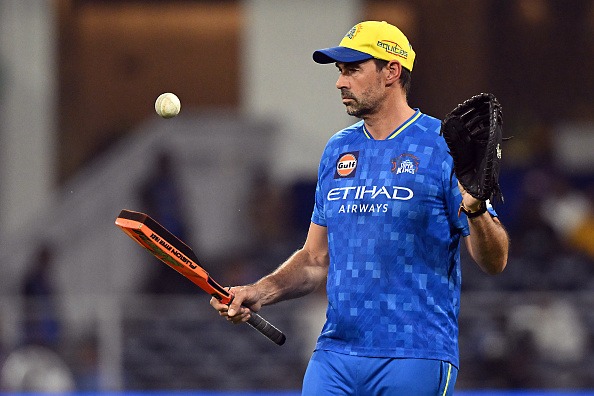
Stephen Fleming, the head coach of the Chennai Super Kings, stated that he is confident in his team’s resources but does not think the traditional finisher’s role is as relevant in modern T20 cricket, citing the trend towards all-out aggression from the onset.
There are voids in the middle and lower order, especially in the finisher’s position, as a result of CSK’s squad reshuffle. The batting unit is dominated by top-order specialists.
“Look, I don’t think there is a thing called finishers anymore. It’s right from ball one, everyone is going at a rate of knots. It’s not build up to the 16th over and then go harder. Everyone’s going hard from ball one,” PTI quoted Fleming as saying.
“So, the run rates of 10, 11, 12 all the way through are what’s expected, and you’re not really getting the big peaks towards the end. It’s just a more aggressive approach to get to 40. So, you actually have to have players all the way through that are going to be aggressive, and that’s certainly the team that we’ve got.
“Keep in mind, we’ve got Brevis on the sideline, and we’ve got one of the best finishers in MS (Dhoni) who’s injured; so there’s some power there, but Brevis through the middle. I’m really content with the pace that we can go.”
T20 World Cup winning batter Sanju Samson, who was acquired from the Rajasthan Royals before the season began, had poor scored in his first two games. Fleming, however, backed the opener, stating that two innings failure is not a cause for concern.
“He’s training well, and when he gets going, he’s often a match-winner and wins games. So, two winnings don’t define an area of concern at all.”
The ‘Impact Player’ rule, according to Fleming, has skewed the game in favor of batting, thus he also urged for a better balance between bat and ball.
“I think with this competition in particular, the impact player rule has a massive part to play. Other tournaments around the world, it’s not as frantic as this. I’m not sure how much longer it’s here, or if it’s here to stay, but that certainly changes the dynamics of cricket and probably sways it a little bit towards batting power,” he said.
He continued by saying that as the game develops, finding and acquiring the appropriate skill has grown more difficult.
“Constantly around the world, evaluating what’s happening and how guys are playing. One of the greatest challenges in T20 franchise cricket is securing talent. And that, through competitions, is becoming difficult as teams bundle players.
“But we are constantly looking at where the game is going next and trying to secure players that we think will be the next big thing, or where the game will go.
“So, again you say, how long is the impact player rule here? Will all-rounders come back into the game, or will it continue to be a dashes, an aggressive batting style? I don’t know. I’d like to see the balance between bat and ball a little bit more. But look, I’m constantly, with others, looking at that and trying to stay as relevant as possible.”
PBKS’s chase of 210 got off to a fast start thanks to opener Priyansh Arya’s 11-ball 39, and fellow batsman Shashank Singh commended him for his mental clarity.
“We know with IPL, the second season is the most important. Because the teams do find the weaknesses in you. But with Priyansh, what we as a team really liked last year is that he’s mentally very tough. He doesn’t speak much. But he’s very mentally tough,” he said.
“He knows his role, and he knows his areas where he can score runs. He’s very young, but the way he’s matured regarding his batting, I think, is fabulous. I think he will do well for sure because technique was never an issue for him.
“If you see his batting, he is quite compact, he hits the ball well, he tries to middle it, he doesn’t try to over hit. So all those things which are required especially by an opener, I think he has it. I am very happy for him.”