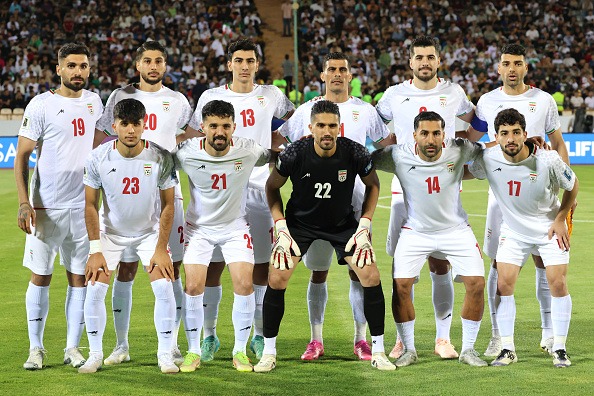
The topic of whether the Iranian national team will participate in the World Cup later this year—during which it is scheduled to play group matches in the United States—has been raised by the Middle East conflict brought on by US and Israeli strikes on Iran.
In Iran, there has been talk of a potential World Cup boycott.
Mehdi Taj, president of the Iranian Football Federation, stated on Iranian television just hours after the combined US-Israeli bombing started on Saturday: “What is certain at the present time is that with this attack and this cruelty, we cannot look forward to the World Cup with hope.”
Taj also declared the suspension of the Iranian domestic league.
The Iranian national squad, referred to as “Team Melli,” qualified for a fourth consecutive World Cup in March of last year. Iran are scheduled to play two games in Los Angeles and one in Seattle after being placed in Group G alongside Belgium, Egypt, and New Zealand.
Since the Islamic Revolution in 1979, a sizable Iranian diaspora has resided in Los Angeles. The Pahlavi dynasty, which was toppled during the revolution, was supported by a sizable portion of that diaspora.
The governing body of international football is still wary of Iran’s potential withdrawal from the World Cup.
“We had a meeting… and it is premature to comment in detail, but we will monitor developments around all issues around the world,” AFP quoted FIFA secretary general Mattias Grafstrom as saying on Saturday.
According to a FIFA source, there have been no talks with the Iranian Football Federation about the team’s potential withdrawal from the competition.
The opening match of the tournament is exactly 100 days away on Tuesday, and FIFA president Gianni Infantino, who has been eager to demonstrate his tight ties with US President Donald Trump, may find the situation in Iran extremely uncomfortable.
This is especially true given that Saudi Arabia, Qatar, and Jordan are all being targeted by Iranian strikes in retaliation, drawing other Gulf nations who are scheduled to participate in the World Cup into the conflict.
FIFA’s rules do not allow a qualified side to boycott the World Cup. If Iran needed to be replaced with another team, “specific decisions” would need to be made, according to a source close to the world football governing body.
According to Article 6 of the 2026 World Cup regulations, “if a participating member association withdraws…as a result of force majeure,” FIFA “shall decide on the matter at its sole discretion and take whatever action is deemed necessary.”
FIFA is therefore free to do as it pleases and “may decide to replace the participating member association in question with another association” in the event that a team withdraws or is disqualified from the competition.
It would seem reasonable that another Asian country may eventually replace Iran in the competition.
Currently, eight Asian teams have earned a spot in the first World Cup, which will include 48 teams overall. If Iraq defeats either Bolivia or Suriname in an intercontinental play-off that is set for March 31 in Monterrey, Mexico, there may still be a ninth Asian team.
Olympic boycotts have occurred, most famously during the Cold War in Moscow in 1980 and Los Angeles four years later. However, a similar circumstance has not yet occurred at a World Cup.
For various reasons, a number of eligible teams withdrew from the 1950 World Cup. Scotland stated they would only attend if they won the 1949–50 British Home Championship; FIFA stated that the top two of the four countries would qualify, but Scotland came second to England and declined to go. Turkey claimed financial concerns.
Yugoslavia qualified for the 1992 European Championship, but just two weeks before the competition started, UEFA replaced them with Denmark, who had trailed Yugoslavia in their qualifying group, due to the start of the war in the Balkans. The award was later won by Denmark.
Since the Russian invasion of Ukraine in February 2022, FIFA and UEFA have banned Russian clubs and national teams from all international events.