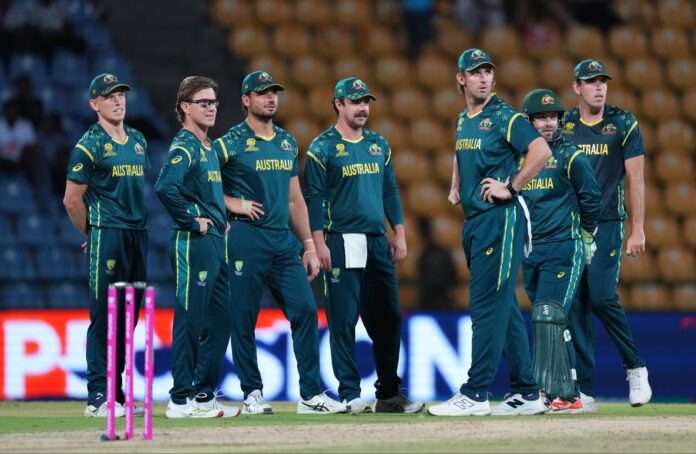
Although Australia’s coach Andrew McDonald is certain that the players he brought to the Twenty20 World Cup were competent, the evidence points to a rebuild before they co-host the next competition with New Zealand in 2028.
For the first time since 2009, the erstwhile white ball heavyweights lost badly in the group stage, despite the 2021 winners being considered as title contenders once more at the marquee tournament in India and Sri Lanka.
An irate media that was expecting more and a substantial pile-on from previous Australian greats await them when they get home. Their criticism of the failing players and alleged selection errors has been swift.
“We said at the start of this World Cup that we were concerned about Australia. All of a sudden, the aura of that Australian team is no longer there when other teams play it … unfortunately, not surprising,” AFP quoted pace legend Glenn McGrath telling reporters that the lack of Mitchell Starc, Josh Hazlewood, and Pat Cummins, three fast bowlers, revealed a soft side.
When the Aussies were outplayed with bat and ball in a three-game warm-up match against Pakistan, the caution signs were already glowing before the event even began. They lost those games by 22, 90, and 111 runs, which were Australia’s biggest losses in T20 internationals.
Captain Mitchell Marsh said at that time: “Absolutely no stress from our end.”
That quickly changed to : “It’s a devastated group” as their T20 campaign came to a disastrous end with defeats to Zimbabwe and Sri Lanka.
The three Australian selectors, George Bailey, McDonald, and Tony Dodemaide, have drawn special criticism for their persistent belief in underperforming all-rounders Cooper Connolly and Cameron Green.
Additionally, they received criticism for their puzzling decision to bench Steve Smith and to drop Matt Renshaw, who was playing well, for the match against Sri Lanka while they were still mathematically viable.
“Look at the selections, look at (Glenn) Maxwell, Connolly, Green and (Josh) Inglis, these guys are all out of form. The selectors have their plans in place, but you’ve got to be smart enough to see which players are in form and which players are out of form. And you’ve got to play the percentages a lot better than what our selectors have played,” lamented Mark Waugh, himself a former selector.
“There will always be differing opinions from the outside,” a defiant McDonald stated, implying that they “don’t understand what the moving parts are and the conversations are on the inside.”
“The build into this tournament and the style of cricket, the balance of our batting unit and the balance of our bowling attack, we felt really confident coming into this tournament,” McDonald added.
“I think the decisions that we made and the squad that we picked, we’ve got a room full of players that are incredibly disappointed knowing that they were good enough to progress, and we’ve just got to own the fact that we haven’t.”
After they return home, a rigorous analysis of their appalling performance will begin in preparation for the upcoming T20 World Cup, in which just three members of the current squad—Green, Connolly, and fast Xavier Bartlett—shall be younger than 30.
It remains to be seen what happens to several of their aging champions, including Maxwell, Marcis Stoinis, Hazlewood, and Cummins. The shortest format of the game has already seen Starc bow out.
McDonald pointed out that Australia’s T20 schedule was low moving forward, with a one-day World Cup in 2027 and a hefty Test burden ahead, providing them with few opportunity to hone the team in the near future.
“In the next 12 months, we’ll have a lack of T20 cricket, as is the way of the schedule. We go to Bangladesh and we’ve got a series against England. They won’t really ramp up until pretty much that World Cup year, which is similar to what happened in this cycle. That’s probably not enough to start to build out what your direction is. I think that’ll come a little bit closer,” he said.