Sluggish surfaces that don’t react well to big bat swings, a stomach ailment that depleted his energy, or the emergence of some previously undiscovered technical vulnerability against spinners?
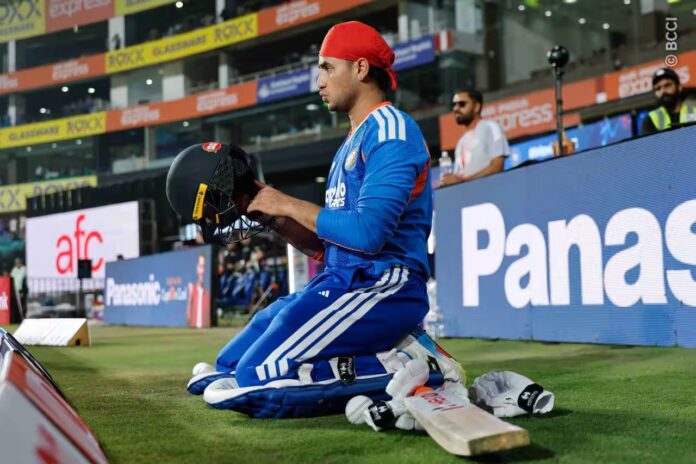
Despite his three straight ducks, Abhishek Sharma’s problems in the current T20 World Cup are as much a topic of discussion as India’s flawless campaign.
However, many who have followed the format and the man—who is suited for it—are willing to attest that “form is temporary, his confidence is permanent” and that a major event in the Super Eight stage is quickly approaching.
Because he returned to professional cricket less than a week after being hospitalized, the prolific opener, who has a monstrous strike rate of 192+, is experiencing an unexpected lean period and his cause has also been hampered by the slow pitches.
The team’s combined strength has so far been able to prevent any negative effects on the outcomes, but with the Super Eights starting on Saturday, it would be imperative that his bat speaks clearly. India’s first game of the stage is against South Africa on February 22.
In addition, Proteas captain Aiden Markram may be inclined to urge his slow left-arm orthodox teammate George Linde to keep things tight or bowl his quick off-breaks inside the Powerplay after closely observing his past dismissals, rather than starting with Kagiso Rabada or Lungi Ngidi at both ends.
In the shortest format, when there is very little room for error, the qualitative difference between traditional cricketing nations and the proverbial minnows has significantly decreased.
Therefore, it is not concerning that Abhishek is unable to open his T20 World Cup account. He might find his rhythm again in the match against South Africa, or in the subsequent Zimbabwe encounter in Chennai, or perhaps in the West Indies match in Kolkata.
USA pacer Ali Khan set a straight-field trap in the opening league match by putting a deep cover for his preferred lofted cover drive. Off-spinners Salman Ali Agha and Aryan Dutt then put an end to the prolific southpaw’s miserable run.
Perhaps, however, Abhishek’s weakness is not off-spin in particular. Instead, he has been undone by the slowness of surfaces at the Wankhede, Colombo, and Motera.
However, given of his expansive bat swing, which gives him great success on speed-friendly tracks, the slow pace of the wickets could be his downfall. For a batter like Abhishek, who has a long bat swing and likes to chase the ball fiercely, “pace-off deliveries”—slower bouncers, cutters, and knuckleballs—are always a problem.
This is the first time Abhishek has faced ongoing difficulties since the beginning of his international career. It makes sense that there has been some self-doubt and superstition associated with it, as evidenced by his wearing the jerseys of Mohammed Siraj and Arshdeep Singh, possibly in an attempt to attract some good fortune.
The advantage of playing in a boom-or-bust format like T20 is that players don’t have much time to emotionally recover due to the short turnaround time. They also don’t have the cerebral capacity to obsess over their mistakes. A few setbacks won’t disturb Abhishek’s self-assured demeanor, but he is aware that a big portion of India’s T20 World Cup campaign depends on his starts.