The year 2025 truly belonged to India’s trailblazing sportswomen, who were an unstoppable force across disciplines, whether it was in the violent boxing ring, the rough and tumble of a cricket field, the mental games on a chess board, or finding the exact target in shooting and archery.
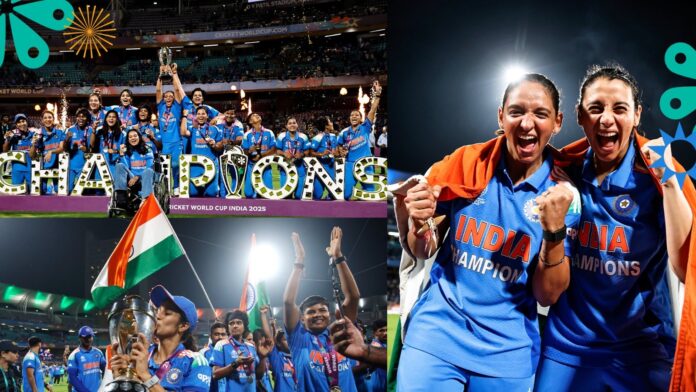
India’s first female World Cup winner was Divya Deshmukh, a 19-year-old chess prodigy. In defiance of all expectations, the Harmanpreet Kaur-led cricket team triumphed in the ODI format despite a challenging period and social media taunts.
Another 19-year-old, Suruchi Singh, made her mark at the shooting range by winning four World Cup gold medals, including three solo ones, in the 10-meter air pistol competition. Up until now, Manu Bhaker, a double Olympic champion, had dominated this category.
On Sunday, November 2, India defeated South Africa by 52 runs at the DY Patil Stadium in Navi Mumbai to win their first Women’s World Cup.
After South Africa crushed England and India chased down a record target to defeat defending champions Australia in the semi-finals, a new champion in women’s 50-overs cricket was assured.
With this victory, India became the only nation to win the main event, along with Australia, England, and New Zealand.
On the football field, the women provided a ray of optimism by making it to the AFC Asian Cup the next year, while the men struggled from one setback to another.
With just one victory, they were able to salvage the face of a sport that is under intense scrutiny due to routinely subpar men’s results and administrative breakdown under the current president of the All India Football Federation (AIFF), Kalyan Chaubey.
Sheetal Devi, an 18-year-old wonder woman, not only became the first armless para world champion in the archery arena, but she also qualified for the national squad to compete internationally against able-bodied athletes. By achieving this, the extraordinary young woman from Kishtwar, Jammu and Kashmir, became the living example of the Olympic spirit that inspires athletes to strive for strength, speed, and higher goals.
However, the Indian blind women’s cricket team also brought back a world title from Sri Lanka, so she wasn’t the only one to make a statement. These women, led by Deepika TC, shared heartbreaking stories about how, while chasing a World Cup, even three meals a day was considered luxury.
Even after winning the trophy, they weren’t looking for a windfall, but when some sponsors and state governments offered to help them out financially, things would undoubtedly improve.
The men in the boxing ring found it difficult to get through the year, but Jaismine Lamboria and Minakshi Hooda’s gold medals from the world championship revived their spirits. Of the two, Jaismine is a serious contender for a medal in the 2028 Los Angeles Games because she competes in the Olympic-approved 57 kg division.
For another year, Mirabai Chanu’s dominance in weightlifting seemed unassailable. Even though she wasn’t even close to her best, the diminutive Manipuri, who rose to national prominence with a captivating smile and a silver medal at the Tokyo Olympics, remained the one to beat.
Despite being hindered by a persistent back problem, Chanu won a gold medal at the Commonwealth Championships and a silver medal at the world championship. It will be interesting to see how she recalibrates her path to the 2028 Los Angeles Games now that her desired 49kg division is no longer included in the Olympic roster.
Antim Panghal ensured that Olympic bronze-winner Aman Sehrawat’s lackluster performance wasn’t the year’s main talking point on the wrestling mat as well. Given that Indian wrestling had little to celebrate because of doping scandals and grapplers like Aman showing up overweight in the biggest tournament, her bronze at the world championship was worth its weight in gold.