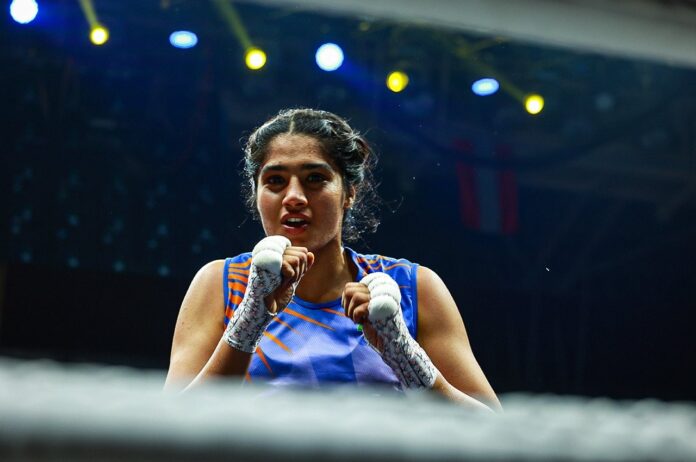
Before the men and women who genuinely trade blows for a living saved the year with the rise of two new world champions in Jaismine Lamboria and Minakshi Hooda, Indian boxing experienced a very unsettled 2025 with the administrators embroiled in acrimonious litigation disputes.
After a medal-less Olympic campaign, boxers missed the majority of international competitions, making the start of the year particularly uninteresting.
But behind the scenes, internal conflict within the Boxing Federation of India (BFI) was consuming the sport.
Athletes caught in the crossfire as different camps inside the federation clashed, causing selection plans to stagnate, national championships to be interrupted, national coaching jobs to become vacant, and international exposure to suffer.
The BFI elections, which were scheduled for February 3 but were continually postponed, were at the heart of the crisis.
The Indian Olympic Association (IOA) appointed an ad hoc committee to oversee the federation as a result of this. The Delhi High Court later stopped the action when the BFI declared it to be unlawful.
Allegations of financial impropriety, power abuse, and ceaseless territorial conflicts inside the federation soon emerged. Due to alleged financial irregularities, the Ajay Singh-led BFI terminated treasurer Digvijay Singh and secretary general Hemanta Kalita, which sparked legal challenges.
Anurag Thakur, a former sports minister, received support to run against Singh for president during the unrest, but his candidacy was turned down after Singh issued a contentious decree on March 7 that declared him ineligible for the electoral college. The Himachal Pradesh Boxing Association, Thakur’s faction, and the Delhi unit, whose chief’s name was excluded from the electoral college on a similar basis, both went to court.
Both questioned the directive’s validity. A protracted and unsightly power struggle ensued. Even the Returning Officer quit, blaming a smear campaign against him, as the mudslinging got that bad.
The boxers were directly impacted by the unrest. The November 2024 senior women’s National Championships were supposed to take place, but they were constantly rescheduled. In March, they were finally detained amid controversy. Boxers from a number of state units were prohibited from competing, notably Madhya Pradesh and Assam.
Assamese bronze medallist Lovlina Borgohain had to withdraw her name due to the struggle. As the elections continued to be postponed due to legal fighting, World Boxing, the international governing body of the sport, intervened to form an interim committee and appointed Singh as its chief to manage the BFI’s business.
Rival groups once again sought judicial intervention after the interim committee changed the BFI constitution in accordance with the World body’s order, making the March 7 mandate a provision. In August, despite ongoing legal proceedings, Singh was re-elected as BFI president for a third straight term, breaking the impasse.
However, the IOA and the Sports Ministry declined to send observers to the poll, casting doubt on its validity. Dissension has simmered even after the new body was chosen. Some state units assert that they have challenged the legality of the modified constitution by filing a no-confidence resolution against Singh, who refuted the allegations, pointing out that a number of the same members had also signed paperwork expressing their continued faith in him.
Indian boxers become comfortable in the ring once the emphasis shifted back to competition. D Chandralal for the women’s squad and Dharmender Yadav for the men’s team were named as new national coaches. After competing in the World Boxing Cup’s Brazil and Kazakhstan legs, the Indian team returned with satisfactory results.
However, due to World Boxing’s efforts to establish an international calendar after just obtaining IOC recognition earlier in the year, participation in all of the events was restricted. Jaismine (57 kg) and Minakshi (48 kg) won gold medals in the World Championships in Liverpool, which was the year’s high point.
India’s increasing power in women’s boxing was confirmed as Pooja Rani (80 kg) and Nupur Sheoran (80+ kg) contributed to the glory with bronze and silver, respectively.
However, it wasn’t a perfect picture.
Well-known performers like Borgohain and Nikhat Zareen, who made a comeback after a protracted injury layoff, did not live up to expectations. It’s also important to note that, aside from Jaismine’s victory, the other podium finishers occurred in non-Olympic weight divisions, where there was less competition.
However, Jaismine seems to be a boxer from India who has a real chance to win an Olympic medal in 2028. She overcame Julia Szeremeta of Poland, a silver medallist from the Paris Olympics, in the Worlds final, demonstrating her consistency throughout the season.
Conversely, the men’s performance in the Worlds was a humiliating low; for the first time in 12 years, they returned without a single medal.
However, there were encouraging indications. After stepping out of Shiva Thapa’s shadow, youngster Abhinash Jamwal demonstrated he could succeed at the top level; Sachin Siwach and Pawan Bartwal also showed promise.
The much-anticipated season-ending World Cup finals were held in India, where the hosts had tremendous success and won a record 20 medals, including nine gold.
However, the draws were slim, the top-ranked boxers did not compete, and podiums in the heavyweight divisions were given out simply for showing up.
An intriguing new chapter began shortly after the event with the announcement of former high-performance director Santiago Nieva’s return, this time as head coach of the women’s team.