
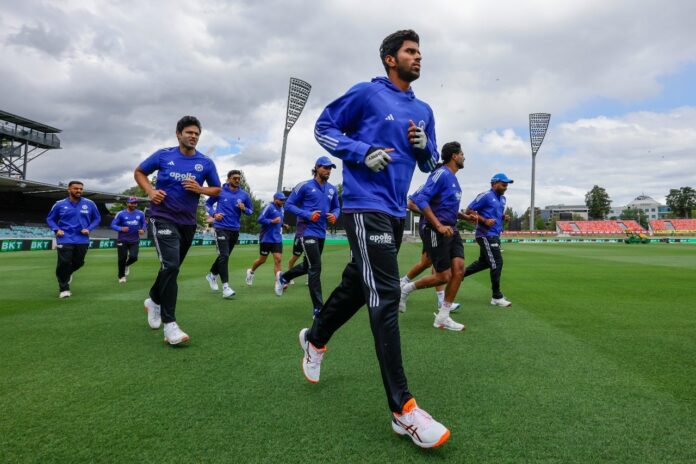
When India plays Australia in the first T20 International on Wednesday in Canberra, the leader in Suryakumar Yadav will encourage the batter in him to take center stage and begin making a significant contribution with the willow.
Given that both nations have won eight of their last ten Twenty20 International matches with one loss apiece, it looks to be a close contest. Australia had one game washed out, while India had one tied game.
The Indian T20 team has been the best of three national teams, practically running on autopilot with the new players taking on their positions like fish to water, even though the captain’s protracted bad patch is still a cause for concern.
With 23 victories in 29 games since being named captain, Suryakumar’s record has been outstanding, following the new model of fearless cricket where every batter goes all guns blazing from ball one.
With an all-win bilateral series record and the Asia Cup victory, Surya’s aggressiveness at all costs and his own leadership abilities have worked incredibly well—albeit against some second-tier continental teams, like Pakistan, who are far behind India in terms of skill, quality, and execution.
With 15 games to get into the swing of things, the Australia series is the start of India’s actual preparation for the T20 World Cup early next year.
However, it may be said that the outcome of this series won’t have much of an impact because the next ten matches against South Africa and New Zealand will take place in familiar conditions, much like what they would probably encounter in the T20 World Cup.
The increased bounce on Australian grounds will be a new challenge for someone like Abhishek Sharma, who became the talk of the town at the Asia Cup, thus the captain’s role is even more crucial.
Not only would it be a fresh set of questions for someone like Abhishek, but it will also be an old set of questions for the Indian captain, whose detractors often point out that he hasn’t scored against major teams in recent years.
If Indian batsmen can score a respectable amount, Varun Chakravarthy’s guile and Jasprit Bumrah’s presence will be crucial components of the bowling attack.
In addition to Bumrah and Arshdeep’s opening overs against Travis Head and the formidable Mitchell Marsh, the 12 overs from Varun, Kuldeep Yadav, and Axar Patel will be crucial.
Mitchell Owen, Australia’s rising T20 star who played for the Punjab Kings last year, will also be the center of attention. Owen was excellent against India in a recent ODI in Adelaide, but the prospect of 12 overs of slow bowling will undoubtedly put his hitting prowess to the test.
Teams:
India: Suryakumar Yadav (C), Abhishek Sharma, Shubman Gill (VC), Tilak Varma, Nitish Kumar Reddy, Shivam Dube, Axar Patel, Jitesh Sharma (WK), Varun Chakaravarthy, Jasprit Bumrah, Arshdeep Singh, Kuldeep Yadav, Harshit Rana, Sanju Samson (WK), Rinku Singh, Washington Sundar
Australia: Mitchell Marsh (c), Sean Abbott (games 1-3), Xavier Bartlett, Mahli Beardman (games 3-5), Tim David, Ben Dwarshuis (games 4-5), Nathan Ellis, Josh Hazlewood (games 1-2), Glenn Maxwell (games 3-5), Travis Head, Josh Inglis, Matthew Kuhnemann, Mitchell Owen, Josh Philippe, Tanveer Sangha, Matthew Short, Marcus Stoinis