
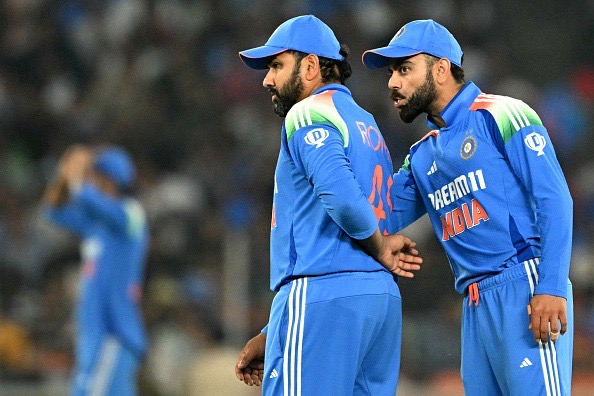
Former India head coach Greg Chappell believes that Rohit Sharma’s grace and humility, along with Virat Kohli’s passion and disengagement from personal glory, would be immortalized in the hearts of cricket fans forever.
Rohit and Kohli are nearing the end of their final Australian tour rather than the start, and Chappell believes that the impact they have left behind transcends mere statistics.
“Now, as the cricketing world moves forward, new names will rise. New captains will lead. But this golden chapter – the Kohli-Rohit era – will remain engraved not just in record books but in the hearts of every fan who understood what they stood for,” Chappell wrote in his column for the ESPN Cricinfo.
According to the former Australian legend, it would be a disrespect to Kohli to simply place him in the pantheon of batting greats.
“Kohli was never just a batter, he was a movement. He brought what few dared to a warrior’s mindset. He turned India’s ODI side into a sharp, focused and supremely fit unit that played to win, home or away.”
He then went on to analyze their characters, games, and fundamental beliefs.
“Kohli’s passion, his refusal to settle, his belief in legacy over statistics. Rohit’s elegance, his humility, and his redemption arc, which reminded us all that timing is everything – in cricket, and in life.”
Chappell made sure to note that he wasn’t fixated on stat-padding like some of Kohli’s predecessors were.
“But what truly set him (Kohli) apart, even from the legends who came before him, was his detachment from personal statistics. While the world raved about centuries and aggregates, Kohli cared only about the outcome.
“He once said that he played for India, not for records – a statement that defined his leadership. Individual feats were often the focal point of India’s cricketing narrative; Kohli sought something larger. His currency was legacy, not numbers,” Chappell wrote.
In Rohit’s case, it was the opening of his innings that made him a red ball titan capable of methodically destroying opponents.
“Where Kohli’s rise was meteoric and defined by intensity, Rohit’s journey was more about a slow-burn path to greatness. For years he dazzled in limited-overs cricket; his timing, poise and flair made him a household name,” Chappell wrote.
“But it didn’t come easy: though he made his debut in 2007, inconsistency and middle-order struggles kept him from cementing a place, especially in big tournaments.”
It was belief, not technique, that set Rohit 1.0 apart from Rohit 2.0.
“Then came 2013. Promoted to open during a home series against England, he seized the opportunity with quiet confidence. There was a double-century against Australia. Elegant hundreds, of which the first came also against Australia that year,” Chappell recollected.
“Sudden comfort against the swinging ball. Something had changed – not just in technique but in belief. What followed was one of the most remarkable second winds in Indian cricket. Rohit didn’t just adapt to ODI cricket, he conquered it,” he further wrote.