
Former England captain Michael Atherton has advocated for a total ban on cricket between the two fierce rivals, claiming that draws have been “neatly arranged” to guarantee India-Pakistan matches in ICC competitions for “economic needs” and that the game has turned into a “proxy for broader tensions and propaganda”.
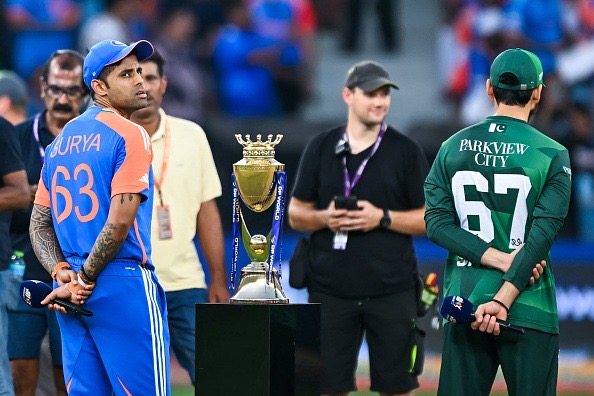
The recent “antics” at the Asia Cup, where the Indian team refused to shake hands with Pakistani players and Mohsin Naqvi, the Pakistani head of the Asian Cricket Council, walked away with the winner’s trophy after the Indians refused to accept it from him, were mentioned by Atherton in a scathing column for “The Times.”
“India and Pakistan have played each other in the group stage of every ICC event since 2013, which includes three 50-over World Cups, five T20 World Cups and three Champions Trophy,” Atherton said.
“That is regardless of whether the initial stage has been a single round robin – part of the motivation for which is the inevitability of an India versus Pakistan fixture – or multi-group, when the draws have been neatly arranged to ensure the fixture goes ahead,” he added.
After 26 Indians were shot dead by terrorists supported by Pakistan in the Pahalgam terror assault, which prompted India to launch a military response in May, tensions between the two nations are at an all-time high.
“Despite its scarcity (maybe, in part, because of its scarcity) it is a fixture that carries huge economic clout, one of the main reasons why the broadcast rights for ICC tournaments are worth so much – roughly USD 3 billion for the most recent rights cycle 2023-27,” Atherton wrote in The Times, London.
“Due to the relative decline in the value of bilateral matches, ICC events have grown in frequency and importance, and so the India and Pakistan fixture is crucial to the balance sheets of those who would not otherwise have any skin in the game,” he said.
According to Atherton, the “tacitly supported arrangement” that guarantees the two bitter rivals will face off at least once in ICC events should be terminated. The two teams played each other every Sunday for the duration of the three-week Asia Cup according to the draw and scheduling.
“If cricket was once the vehicle for diplomacy, it is now, clearly, a proxy for broader tensions and for propaganda. There is little justification, in any case, for a serious sport to arrange tournament fixtures to suit its economic needs and now that the rivalry is being exploited in other ways, there is even less justification for it.
“For the next broadcast rights cycle, the fixture draw before ICC events should be transparent and if the two teams do not meet every time, so be it,” Atherton said.
Since the 2008 Mumbai terror attack, India and Pakistan have not had any bilateral interactions. To ensure that the nation complies with the Olympic Charter, the Indian government announced a policy a few days prior to the Asia Cup that would outright forbid bilateral sports between the two nations, even at neutral venues, but would exempt multilateral competitions.
According to Atherton, the two nations are purposefully luring one another in order to profit from the tension that attracts the audience and viewership that are essential for generating a healthy amount of advertising money.
“This ‘arrangement’ has been tacitly supported within the game for a number of reasons. The most obvious is the inability of both teams, because of political tensions, to meet outside ICC events.
“Cricket on each other’s territory was once the avenue through which both countries might talk, but gradually silence has descended.
“ICC events are the only occasions, at present, when the fixture can go ahead and now this must be on neutral territory too the cause of much debate in the most recent Champions Trophy, when India parked themselves in Dubai for an entire tournament nominally hosted by Pakistan,” he pointed out.