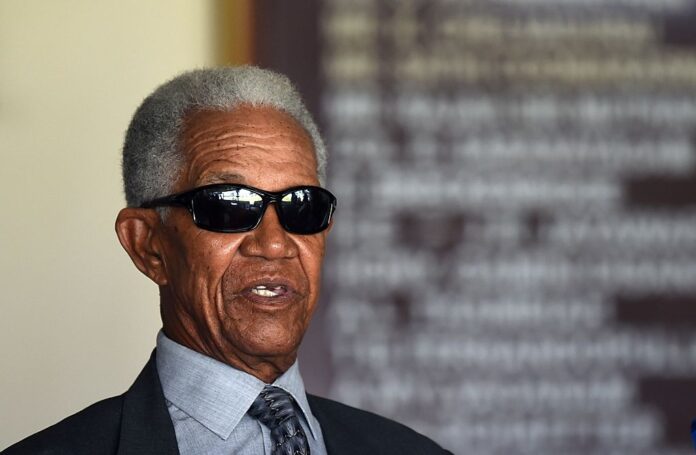
There were many outstanding cricketers in the 20th century, but by general agreement, two stand out above the others: Australian batsman Donald Bradman and West Indies all-rounder Garry Sobers, who passed away at the age of 89.
“A great innings has come to an end. In our hearts, now and forever, Sir Garfield Sobers,” West Indies Cricket posted on social media on Friday.
Bradman and Sobers were selected as Wisden’s Five Cricketers of the 20th Century in a 1999 poll of 100 cricket experts, with the West Indian all-rounder receiving 90 votes.
Even though Bradman received an incredible 100 votes, the Don gave Sobers the highest honor before his own demise in 2001.
“He is, in my opinion, the greatest cricketer of all time,” the Don had said.
That praise is predicated on the astounding range of Sobers’ cricketing talent rather than just the stats or flair, which he possessed in abundance.
In his 93 Test matches as a batsman, Sobers amassed 8,032 runs at an average of 57.78, stats that alone would secure him a spot in any pantheon.
Sobers was also a bowler, taking 235 wickets at a rate of 34.03 runs per wicket. He would occasionally open with a quick left-arm, but if the pitch was breaking up, he would turn to the orthodox or wrist left-arm spin that initially caught the notice of the West Indies selectors when he was a teenager.
As captain, he would put himself in danger at short-leg by bringing off-spinner Lance Gibbs into the attack, but he was also a speedy fielder, taking 109 Test catches, frequently at slip.
Born on July 28, 1936, in Bridgetown, Barbados, Garfield St. Aubrun Sobers—also known as Gary and Garry—was the fifth of six children.
At the age of six, his father Shamont, a merchant seaman, lost his life when two German U-boat torpedoes struck his ship, CNS Lady Hawkins, off the coast of North Carolina.
Sobers had great early potential in a number of sports. At the age of 16, he made his Barbados debut as a spinner in January 1953 against the Indian tourists.
After just two first-class matches, he was chosen to replace the ailing Alf Valentine for his Test debut against England at Sabina Park in March 1954 after playing against the MCC tourists the following year.
Although Sobers made an early impression by dismissing Trevor Bailey in his first over and took 4-75 in the tourists’ first innings, the tourists prevailed by nine wickets.
In Kingston, four years later, he broke a world record by switching to a different level against Pakistan.
Len Hutton’s 364 against Australia at the Oval has been the highest individual score in Test cricket since 1938. In his first Test century, Sobers scored 365 not out, creating a record that persisted until 1994, when another West Indian, Brian Lara, scored 375 against England.
He struck a scorching 132 in the 1960–61 tied Test in Brisbane, setting the tone for an unforgettable series.
In the 1964–65 home series against Australia, Sobers took over as West Indies captain from Frank Worrell and guided the home team to their first-ever series victory.
West Indies cricket continued to grow and change under Sobers’ leadership, becoming the dominant force of the late 1970s and early 1980s despite inconsistent results throughout his tenure as captain, which ended in 1972 when he passed the reins to Rohan Kanhai.
In 1972, Sobers scored 254 for the Rest of the World at the MCG in what Bradman called “probably the greatest exhibition of batting ever seen in Australia,” notwithstanding his diminishing impact on the field as he grew older.
Outside of the international arena, Sobers represented Nottinghamshire in England’s county competition and assisted South Australia in winning the Sheffield Shield.
He became the first player to hit six sixes in a single over against Glamorgan spinner Malcolm Nash in 1968. Indian all-rounder Ravi Shastri only matched this record once in first-class cricket, in 1985.
After retiring from Test cricket in 1974, Sobers received a knighthood the following year.
Bradman was recognized by the International Cricket Council in 2004 with the Sir Garfield Sobers Trophy for the annual World Player of the Year award, but his legacy as one of the greatest cricket players will live on.