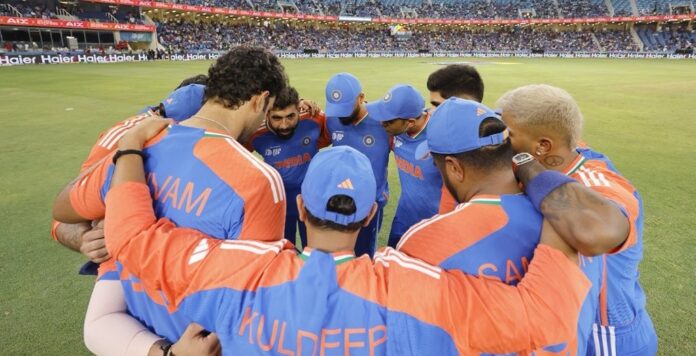
The ‘No Handshake Policy’ that was implemented during the Indian cricket team’s match in Dubai on Sunday was largely influenced by the harsh criticism they received prior to their Asia Cup encounter against Pakistan. This policy would be followed in the two remaining games against the bitter rivals.
The apolitical stance that players typically take on Pakistan contrasted sharply with India’s stance, which will be discussed and argued for some time to come.
“Together, we came here, we took a call and I feel we came here just to play the game. I think we gave the proper reply,” India captain Suryakumar Yadav replied when questioned about his team’s position.
A Pakistani journalist questioned the captain about if it was “politically motivated” to refuse to shake hands with opposition players following the seven-wicket victory, SKY replied: “I feel few things, few things in life are ahead of sportsman’s spirit also. We stand with victims of Pahalgam terror attack and dedicate this victory to our Armed Forces.”
In an interview with Sony Sports Network, head coach Gautam Gambhir shared the viewpoint.
As opposition parties in India and social media erupted in protest against the match, accusing it of putting money ahead of the feelings of families devastated by the Pahalgam terror attack that killed 26 people in April, it is understood that the BCCI and the team management met to discuss their position.
Gambhir and the senior players agreed that they would not shake hands during the game. Senior BCCI officials finally gave their approval after careful consideration, thus the decision wasn’t made overnight.
It should be mentioned that Gambhir has a very clear personal opinion about playing Pakistan — “No sporting ties till terror activities continue on Indian soil.”
It is understood that the “no handshake” guideline will be upheld throughout the Asia Cup if the teams rematch next Sunday in a Super Four Clash and then possibly face each other in the final on September 28.
“Look, if you read the rule book, there is no specification about shaking hands with the opposition. It is a goodwill gesture and a sort of convention not law that is followed globally across the sporting spectrum,” a senior BCCI official told PTI.
“If there is no law, then the Indian cricket team is not bound to shake hands with an opposition with whom there is a history of strained relationship,” he added.
In international sports, refusing to shake hands for political reasons is not new.
Elina Svitolina of Ukraine did not shake hands with Victoria Azarenka of Belarus following her victory in a women’s singles match at the 2023 Wimbledon.
Svitolina had previously stated that she would not shake hands with any Belarusian or Russian player because both nations had attacked her country.
Svitolina and Azarenka were not punished by the Wimbledon organizers for failing to maintain the spirit of sportsmanship.
While sporting rivalry are occasionally ensnared by geopolitical tensions, everyday etiquette is unaffected. For example, despite the political situation, the United States and Iran, two countries who have been at diplomatic odds, shook hands during their World Cup football matches.
However, the atmosphere during Sunday’s Indo-Pak encounter was so intense that the captains did not personally exchange team sheets, instead gave them to match referee Andy Pycroft.
Indeed, it was Pycroft who reportedly urged Salman Ali Agha not to shake hands with his Indian counterpart, according to Pakistan team manager Naved Cheema, who had expressed his disapproval in an Urdu statement.
Harmanpreet Kaur and her teammates’ stand during their Women’s ODI World Cup encounter against Pakistan in Colombo next month would be intriguing to watch.
Although playing Pakistan has drawn harsh criticism, it is important to remember that the Indian government is the one that has decided to permit Indo-Pak cricket matches at multi-nation tournaments.
That has a built-in explanation.
Cricket has now been formally included to the Olympic program for the 2028 Summer Olympics in Los Angeles, and India hopes to host the Commonwealth Games in 2030 and the Olympic Games in Ahmedabad in 2036.
Not playing Pakistan at multi-nation competitions, whether global or continental, can seriously hurt one’s chances of playing host and create very bad optics for the International Olympic Committee if one wishes to host games of this magnitude.
As a result, while cricket matches at the Asia Cup and World Cup will go on, bonhomie is over for the time being.