
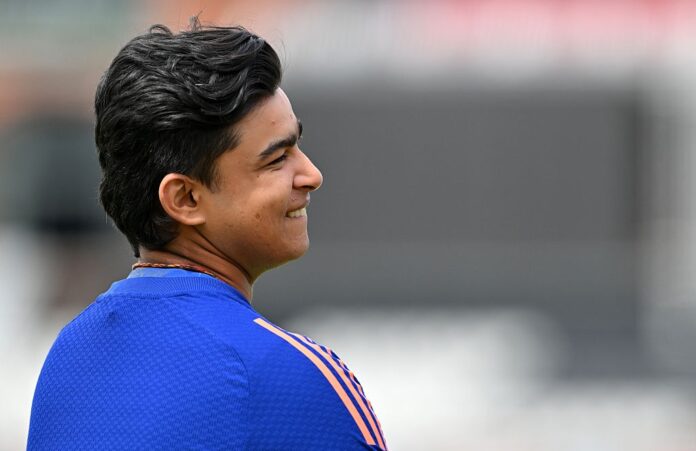
While India applauds batting prodigy Vaibhav Sooryavanshi’s incredible ascent and anxiously anticipates his debut, another dialogue is subtly taking place that goes beyond his bold strokeplay and exceptional elegance.
For many years, elite sports have struggled with the question of how to prevent exceptional talent from taking precedence over a typical childhood when exceptional youngsters grow up and enter adulthood. There are no simple solutions.
Sooryavanshi should be where he is if selection is only based on merit. That argument has been strongly supported by his recent IPL and other tournament performances. However, the plans for his first senior tour serve as a reminder that the newest phenomenon in cricket is still a minor by law.
Although separate changing rooms are required for youngsters in England due to protection requirements, the BCCI has permitted his parents to attend him. A boy who is both young enough to require the safety that comes with childhood and mature enough to take on international fast bowlers.
Keerthana Swaminathan, a renowned sports psychologist, believes that distinction should never be overlooked.
“A 15-year-old is still a child before he’s a star. But we end up interchanging that. We end up thinking he’s a star first and then a child,” Swaminathan told PTI.
“We need to make sure we understand what we can expect from a child. Obviously, they have to have the scope to make mistakes.
“Understanding that they are children first before performers would be really helpful because, when they are performing, they already have to work on a hundred other things. They have to work on their own emotional and mental stability. This is a very high-pressure scenario,” she said.
Perhaps no statistic better expresses the problem than those words. Every generation has marveled at children who can compete against athletes who are much older and physically stronger in sports like football, tennis, cricket, and gymnastics. Some people have justified all of the demands made of them. Others have found that the emotional demands of early popularity cannot be met by talent alone.
There have previously been teenage debuts in Indian cricket. When Sachin Tendulkar faced Pakistan’s formidable pace attack in 1989, he was only 16 years old. He would go down in history as possibly the best batsman of his time. But the time of Tendulkar’s arrival was different.
There were no broadcaster commitments and marketing, no 24-hour television environment ravenous for headlines and rapid opinions, and no social media snippets analyzing every innings.
The flow of praise was slower. Criticism also did. Teenage prodigies of today are raised in a setting where every shot, dismissal, and facial expression has the potential to become public property in a matter of minutes. According to Swaminathan, this alters the psychological terrain.
“I don’t think protection is the only way to go. Now that he’s also in this space, the media is going to talk. Social media is going to talk. Some people are going to talk. Parents can’t take away the sadness or the anger, but they can lend a shoulder and equip children with the tools they need to deal with those emotions,” she pointed out.
Teenage sensations in cricket have also had very distinct professional paths. Some, like Tendulkar, kept all of their commitments. Others, like Prithvi Shaw, declared themselves to be promising but found it much harder to maintain that trajectory at the highest level, demonstrating that early success does not ensure longevity or fulfillment.
According to Swaminathan, the athlete is not the only one who has responsibility. She believes parents, coaches and sporting systems must understand that children perceive success and failure differently than adults.
“I’ve worked quite a bit with parents and coaches. I believe in creating environments where athletes can thrive, where children can actually thrive. Somewhere something gets lost in communication. We end up talking to children like we would talk to a 20-year-old or a 30-year-old. But we forget that they’re actually 15-year-olds,” she said.
She recalls one young athlete telling her: “He said ‘Ma’am, I’m confused whether my parents are happy or not happy. If I play well, sometimes they’re angry. If I don’t play well, sometimes they tell me I’ve done really well. I’m not able to understand’.”
She claims that these instances highlight how quickly adults might forget that adolescence is a time of emotional exploration. She contends that letting kids feel emotions is just as vital as protecting them from all setbacks.
“If a child is feeling sad, maybe learning how to use that emotion while performing… knowing how to reflect is a big tool. People think it’s wrong to have emotions or to be sensitive. But emotions exist for a reason. They can become the biggest teachers.”
The accomplishments of someone like Sooryavanshi are not diminished by any of this. It also doesn’t make the case that extraordinary kids should be excluded from chances just because they are young.
Former South African cricketer Daryll Cullinan, who began his first-class career at a relatively young age, discusses the dangers of pushing young talent into the mainstream too soon in a recent column for ESPNCricinfo.
“In my view he (Sooryavanshi) should be at home preparing for his exams, playing gully cricket with his mates, and being a young boy while he still has the chance. That does not mean ignoring his talent. It means understanding that the talent will only be truly served if the person carrying it is allowed to grow whole,” he wrote.
Former left-arm spinner Maninder Singh, who debuted for India at the age of 17, feels that performance and self-control are essential for keeping a spot on the team.
“I was dropped after my first two tours as in eight Tests, I picked five wickets. I had no one to blame. Yes, umpiring was horrible in Pakistan and also the West Indies but that’s not all. I didn’t play well and I had to make way,” Maninder told PTI, recalling his early days in international cricket.
“Of course there was a support system back then also. There were people who came and told me ‘Listen Manni, you need to work harder’. If I have to blame anyone it will be myself. Now there is a better support system that is working for players,” he said.
If anything, every sporting nation should be proud of the emergence of such exceptional talent. Making sure systems change as quickly as the prodigies they adopt is a challenge.
Every time a remarkable teenager breaks a record, everyone in their immediate vicinity has a more subdued duty to keep in mind that they are still youngsters first and foremost before they become the nation’s newest sporting sensation.